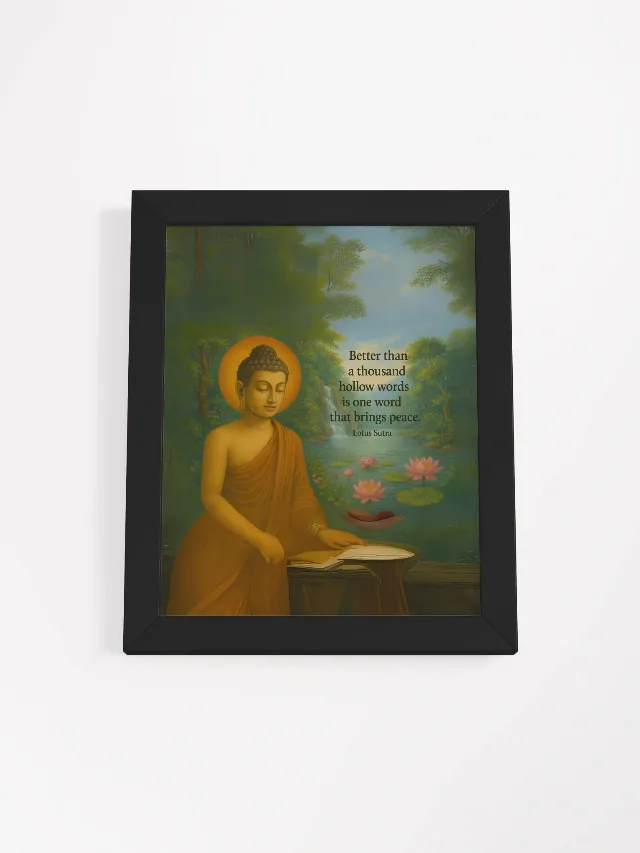
The Expedient Means chapter is the second chapter of the Lotus Sutra. In it the Buddha says that the teachings he gave before were skilful means, suited to their listeners, and that there is really one vehicle: buddhahood for all. The chapter also sets out the ten suchnesses, a plain description of reality as it is.
The Lotus Sutra opens with a scene of assembly. The Buddha is surrounded by monks, bodhisattvas and ordinary people. In the second chapter, the disciple Shariputra asks him to explain the wisdom that the buddhas have realised.
The Buddha begins by saying that this wisdom is difficult to understand. Not everyone in the assembly will grasp it. Some will be confused. The chapter is, in part, about that difficulty. It does not pretend that awakening is obvious.
The chapter is known in Japanese as Hoben-pon. Hoben-pon means the chapter of expedient means, and it is one of the two chapters most often recited in this practice.
The mood of the chapter is important. The Buddha does not announce a doctrine and wait for applause. He says that what he is about to teach is hard to understand, and that some people will not accept it. A large group of monks, nuns and laypeople get up and leave. The chapter is honest about the fact that a universal claim can still meet resistance.
What an expedient means is
An expedient means, or hoben, is a method adapted to the person being taught. It is not a lie. It is a way of meeting someone where they are so that they can move somewhere else.
A teacher who explains algebra to a child with apples is not deceiving the child. The apples are not the final truth of algebra, but they are a true way in. Later the child will not need the apples.
The Buddha's earlier teachings work like this in the sutra's account. They were appropriate for the people who heard them. They were not the whole of what he wanted to say.
The chapter is careful about motive. The point of an expedient means is not to keep people dependent or to conceal the truth. It is to lead them towards it. A method that serves the teacher's power rather than the listener's understanding is not what the sutra is describing.
The one vehicle
The chapter's central claim is that the three vehicles are provisional and the one vehicle is real.
The three vehicles are the paths of the voice-hearer (who awakens by listening to teaching), the cause-awakened one (who awakens through insight into cause and effect) and the bodhisattva (who works for the awakening of others). In the earlier teachings they were presented as different destinations. The Lotus Sutra says they are all ways into the same destination: buddhahood, the state of an awakened person.
This is not a small adjustment. It means that the difference between a monk and a layperson, a scholar and a labourer, a man and a woman, is not a difference in ultimate capacity. Everyone is travelling in the same vehicle, whether they know it or not.
The sutra goes on to tell the story of the burning house in the next chapter, which makes the point in pictures. The father promises three carts and gives one carriage. The children think they are getting different things. They are all getting the same thing, which is more than they asked for.
The ten suchnesses
The chapter also contains the teaching of the ten suchnesses, sometimes called the ten factors. The ten factors are a way of describing anything completely.
They are usually listed as appearance, nature, entity, power, influence, inherent cause, relation, latent effect, manifest effect, and the consistency from beginning to end. The list sounds technical. Its purpose is simple: to say that things are not illusions. They have a character, a history and an effect.
Take a friendship. It has an appearance: how it looks from outside. It has a nature: what it is like from inside. It has a strength, an influence, causes, conditions, and effects. The ten factors say: look at the whole thing, not just the surface.
The same exercise works on a difficult feeling. Jealousy has an appearance, a nature, a power, a history and an effect. When you look at all ten, the feeling becomes less like a verdict and more like an event with a structure. You can see where it came from and what it is doing.
The chapter's phrase for this is the true aspect of all phenomena. Ordinary reality, just as it is, is the place where awakening happens. You do not have to leave the world to find the truth. You have to see the world more clearly.
Why it is recited
In many traditions, daily practice includes reciting the Expedient Means chapter and the Life Span chapter, followed by the daimoku, the chant of the title. Gongyo is the name for this recitation.
The choice is not arbitrary. The second chapter sets out the one vehicle, the claim that everyone can become a buddha. The sixteenth chapter reveals the Buddha's enduring life. Together they frame the practice: what you are aiming at, and who is present with you.
Communities differ on what they recite and how much. Which parts of the Lotus Sutra are recited, and why those? explains the variations. What is consistent is that the recitation is not a performance. It is a way of putting the sutra into your mouth and your day.
A common misreading
The word expedient can sound like a polite word for a fib. That is not what the chapter means.
An expedient means is true for its purpose. It is not the final truth, but it is not false. The distinction is between a partial truth and the whole truth, not between honesty and deception.
A second misreading is that the chapter makes truth relative. If every teaching is a skilful means, then anything goes. The sutra does not say that. It says that the provisional teachings point towards the one vehicle, and that the one vehicle is the standard by which they are judged.
A third misreading is that the chapter is only for scholars. It is not. The point of the one vehicle is that the scholar and the farmer are in the same carriage. You do not need to master the list of ten factors to be included.
Reading it on an ordinary Tuesday
You can read the chapter in ten minutes. Read a paragraph aloud, slowly. Notice where you want to argue or skim.
Then ask one question: where am I treating a provisional answer as the final one? A judgement about a colleague. A story about what is possible for you. A rule you inherited and never examined.
The chapter does not ask you to throw away every provisional answer. It asks you to hold it lightly, the way you hold a map when you are still learning the road.
Try this today. Read the first few paragraphs of the Expedient Means chapter. Then write down one opinion you hold about yourself that might be a provisional teaching rather than the final truth. Chant for five minutes and leave the note where you will see it.
From Nichiren's writings. In The Opening of the Eyes, Nichiren reads the Lotus Sutra's one vehicle as the ground for saying that ordinary people can become buddhas. He treats the earlier teachings as provisional steps rather than the final word, and he asks what that means for the age he lived in.
Next step
Why the Lotus Sutra Matters gives the wider case for the sutra and its place in this practice.
The Life Span Chapter is the natural companion to this chapter, and the other half of the daily recitation.
How to Learn Gongyo Step by Step shows how the recitation is actually done, at a pace a beginner can manage.
When you have read the chapter, set the chant timer for five minutes and let the words settle.