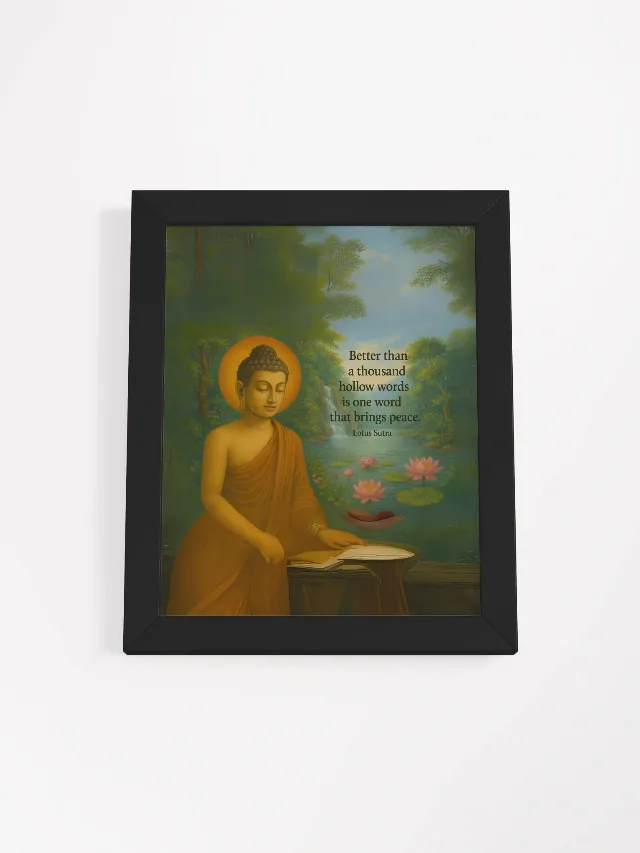
The Treasure Tower is a jewelled stupa rising from the earth in chapter eleven of the Lotus Sutra. Inside sits Many Treasures Buddha, a buddha from the distant past. The tower opens and Shakyamuni, the historical Buddha, takes a seat beside him. That scene begins the Ceremony in the Air, and it teaches that the Law is confirmed across time.
What happens at the Treasure Tower
The chapter begins with a stupa, a dome-shaped memorial tower, emerging from the ground. It is described as tall and wide, made of seven kinds of treasure, and it stays suspended in the air rather than resting on the earth. The treasure tower is one of the sutra's best-known images.
A voice comes from inside the tower, praising Shakyamuni and the Lotus Sutra. The assembly cannot see who is speaking. Shakyamuni explains that it is Many Treasures Buddha, a buddha who lived long before him and who made a vow to appear wherever the Lotus Sutra is taught.
The tower then opens. Many Treasures Buddha, whose name is also translated as Many Jewels, is seated inside and invites Shakyamuni to join him. Shakyamuni does, and the two sit side by side.
What follows is a gathering of buddhas. Shakyamuni creates duplicates of himself, one for each direction, so that every world has a buddha to hear the teaching. Their lands are joined with this one, and the whole assembly is lifted into the air. The scene continues for many chapters.
The chapter is careful to say that the tower does not arrive as a decoration. It arrives as a witness. Many Treasures Buddha has come to confirm that what Shakyamuni is teaching is true.
Why two buddhas sit together
The two figures belong to different ages. Many Treasures Buddha represents the distant past. Shakyamuni represents the present. When they sit side by side, the sutra is showing that the Law is not owned by one teacher or one generation.
There is a practical point in that. A tradition can easily become a loyalty test: do you follow a teacher, a line, a particular way of doing things? The Treasure Tower refuses that reduction. The truth of the Law is confirmed by more than one life.
The scene also answers a doubt that any reader might have. If the teaching is real, why does it depend on one person's word? The tower provides a second witness. In the logic of the sutra, the confirmation is not external evidence. It is the recognition of one awakened life by another.
For practitioners, the image can be a check on certainty. If two buddhas can sit together without one erasing the other, then differences between communities do not have to become a war. Communities differ on many details. What the chapter holds up is shared recognition, not uniformity.
What the tower is made of
The tower is described as being made of seven treasures. It is easy to read that as a promise of material wealth, but the sutra is not describing a bank vault.
The treasures are the materials of something precious and lasting. The tower is adorned because the Law it honours is precious. The wealth in the image is the wealth of a life that has found something worth building on.
Nichiren takes the image further. In his letter On the Treasure Tower, he tells a follower that the tower is not a building somewhere else. It is the person who upholds the Law. The dignity of the tower belongs to an ordinary life turned towards practice.
That reading changes the question you ask of the text. Instead of asking where the tower is, you ask what makes a life a treasure. The letter points to faith and practice, not possessions or status.
The tower is also described as emerging from the earth. Like the Bodhisattvas of the Earth in a later chapter, it comes from the ground rather than descending from the sky. What is precious is not imported from elsewhere. It is already here, waiting to be recognised.
What is the Ceremony in the Air?
The Ceremony in the Air is the long teaching scene that begins with the Treasure Tower and continues through several chapters. The assembly is suspended above the earth. Shakyamuni and Many Treasures Buddha sit together in the tower. The buddhas from the ten directions gather around them.
The setting matters. This is not a quiet conversation in a garden. It is a vast assembly, and the teaching is being witnessed by the whole of the Buddhist cosmos.
The ceremony reaches its turning point near the end, when Shakyamuni entrusts the Lotus Sutra to the Bodhisattvas of the Earth. The people who will carry the teaching are not the visitors from other worlds. They are the ones who rise from this world.
The phrase "ceremony in the air" can sound remote. The air is not a place to escape to. In the sutra's imagery, it is a way of seeing ordinary reality from a different angle. The ground is still there. The assembly has simply been lifted so that it can see further.
Some practitioners find the scene easier to enter through art than through doctrine. A painting of the tower, a statue, or a line of chant can carry the meaning before an explanation does. That is not a failure of understanding. It is another door. The Lotus Sutra guide places the ceremony within the sutra's twenty-eight chapters.
What the scene asks of your practice
The Treasure Tower is a grand image, and it would be easy to treat it as art and nothing more. Its practical claim is smaller and more demanding.
It asks you to treat your own life as the place where the Law appears. Not because you are special, but because there is nowhere else for it to appear. The tower is built out of the materials you already have: your body, your attention, your ordinary days.
It also asks you to let other people be witnesses. Practice can become solitary and self-enclosed. The two buddhas seated together suggest that recognition matters. You need others to see what you cannot see in yourself.
And it asks for patience with the long scene. The ceremony does not resolve in a paragraph. It unfolds over chapters, with speakers arriving, lands merging and the teaching returning again and again to the same point. Practice is like that too. You do not get the whole thing at once.
If you want to connect the scene to the object of devotion, the guide to what the Gohonzon represents, the focus used in practice, explains how practitioners relate to it. The Bodhisattvas of the Earth are the next turn in the story.
How to read the chapter without losing the thread
Read the chapter as a scene rather than a puzzle. Picture the ground opening, the tower rising, the voice from inside. Notice who speaks and who is silent.
Do not worry about the measurements or the lists of treasures. They are there to convey abundance, not to be memorised. The heart of the chapter is the meeting of the two buddhas and the confirmation it offers.
If you read slowly, you may notice how often the scene returns to hearing. The tower comes to hear the sutra. The buddhas gather to hear it. The chapter is less about seeing something spectacular than about listening well enough to be changed.
That is a practice you can carry into a quiet room. Sit down, open the text, and read one page aloud. The ceremony begins wherever someone is willing to listen.
Try this today. Write down one thing in your life that feels like treasure and one that feels like rubble. Do not explain either. Chant for five minutes with both on the page, then put the paper away.
From Nichiren's writings. In On the Treasure Tower, Nichiren tells a follower that the tower of seven treasures is not a structure in some distant place. It is the person who upholds the Lotus Sutra, and its treasures are the qualities of a life lived in faith.
Next step
The Lotus Sutra guide shows how the Treasure Tower fits with the parables and the Life Span Chapter. If the image of the tower stayed with you, read about what the Gohonzon represents and how ordinary practitioners relate to it. And the Bodhisattvas of the Earth takes the ceremony to its turning point.
The videos page has short recordings if you would rather hear the chant than read about it. Either way, five quiet minutes is a good place to begin.