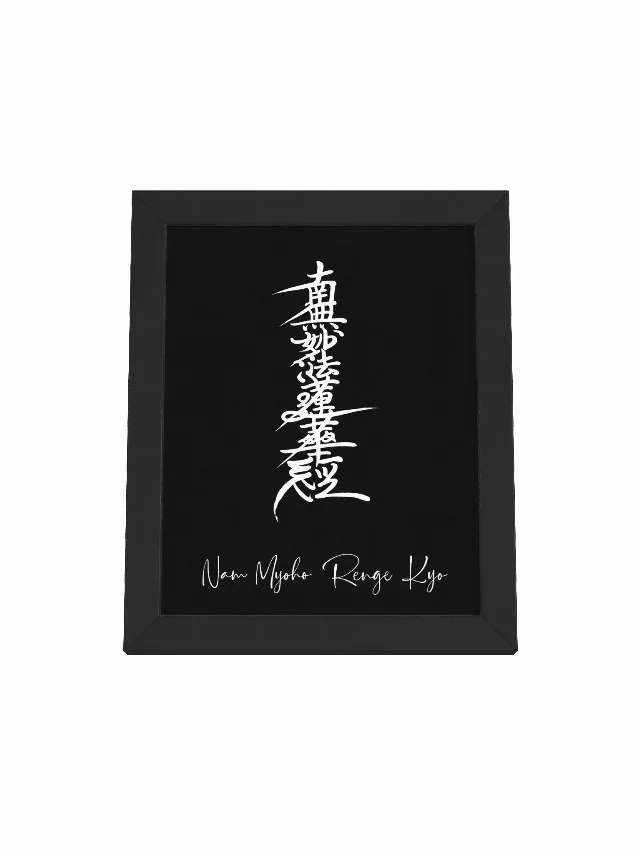
Chanting Nam Myoho Renge Kyo is simple. Sit comfortably with your back upright, rest your hands together, and say the words aloud at a steady pace. Five minutes is enough to begin. You do not need a special room, a statue or perfect pronunciation. You need a little quiet and the willingness to say it again.
This guide covers how to chant Nam Myoho Renge Kyo from your first attempt to a rhythm you can keep: where to sit, how to say the words, how long to continue, and what to do when your mind will not settle.
What is daimoku, and what are you saying?
The practice is called daimoku, which means "title". The title is Nam Myoho Renge Kyo, the name of the Lotus Sutra in Japanese. Chanting it is the practice Nichiren taught for ordinary people: no ritual you must qualify for, no text you must master first, no special state of mind you must reach before you begin.
You are not chanting at a statue or asking a distant figure to change your circumstances. You are turning your attention towards a law of life that the sutra describes, and doing it with your voice and your body. What the words mean is a page of its own, but the short version is this: devotion to the wonderful law of cause and effect that runs through a human life.
The five characters myo, ho, ren, ge, kyo are the title without the opening word of devotion. Nichiren taught that they contain the heart of the sutra, which is why a phrase short enough to remember in a crisis can carry so much weight.
Is chanting a prayer?
It depends what you mean by prayer. If prayer means asking an outside power for a favour, then no. If prayer means steadying yourself, naming what matters, and aligning your attention with something larger than your current mood, then yes, in the way that any repeated, sincere act can be.
People bring a job, a diagnosis, a child, a marriage. The practice does not ask you to pretend those things do not matter. It asks you to name them, and then to act.
What you need before you start
A chair. A wall or a window. A way to keep time. That is the whole list.
You do not need a shrine, incense, or a cushion on the floor. Those things help some people settle, and there is nothing wrong with them, but they are not the practice. If you wait until you have the right equipment, you may wait for years.
Choose a spot you can return to. The end of a bed, a kitchen chair, the corner of a room where the light falls in the morning. Many practitioners describe chanting in a parked car before work, or at the kitchen table with their coat still on. The practice travels well.
Where should you sit, and which way should you face?
Anywhere with a little privacy. A chair with a straight back is easier than a deep sofa. If you sit on the floor, use a cushion so your knees are lower than your hips.
Facing a wall is traditional in some settings, because it reduces distraction. Facing a window is fine. Facing a small altar is fine. No direction is more powerful than another. The point is to stop looking around.
Sit with your feet flat and your hands in your lap. Palms together, fingers straight and lightly touching. Keep your shoulders down and let your jaw be loose. You are not holding a posture for a photograph.
Do you need beads, a bell or an altar?
Prayer beads, called juzu, are a loop of beads held in both hands. They give the hands somewhere to rest and help mark the rhythm. They are useful, not essential. Do not delay your first chant until a set arrives in the post. How to hold them is a short guide for when you have a pair.
A small bell marks the start and end of some formats. It is a signal, not a summons. If you live in a flat with thin walls, a folded cloth under the bell softens the sound.
A butsudan is a home altar: a shelf or small cupboard holding a scroll, a candle, a glass of water, perhaps a flower. Setting one up can be a quiet, grounding act. It can also become a project that keeps you from practising. Start with a chair and a book. Add the rest when you want to. Setting up a simple home altar shows how little is needed.
How to chant Nam Myoho Renge Kyo, step by step
- Sit down and stop moving. Feet flat, back upright, hands together in your lap. Let your weight settle into the chair.
- Decide the length before you begin. Five minutes for the first week. Set a timer and put the phone face down, out of reach. Negotiating with yourself mid-chant is the quickest way to stop.
- Take one slow breath. Let the room be as untidy as it is. You are not waiting for the perfect moment.
- Begin aloud, slowly. Nam Myoho Renge Kyo. Then again. Keep the same pace. Loud enough to hear your own voice, quiet enough that you are not shouting.
- Keep the phrase steady. No melody, no drama. The sound should be even, the way you would read a sentence you wanted someone to understand.
- When you lose the thread, come back. No commentary, no scolding. Return to the next phrase.
- Stop when the timer rings. Sit still for one breath. Then get up and go on with your day.
That is the whole method. Everything else is variation.
A five-minute session, written out
- 0:00 Sit down. Hands together. One breath.
- 0:15 Begin. Nam Myoho Renge Kyo.
- 2:00 Notice where your attention has gone. Return to the sound.
- 4:00 Let the last minute be slower, not faster.
- 5:00 Stop. One breath. Write one word.
A session like this is not a warm-up for a better session later. It is the practice.
How do you finish a session?
Stop at the end of the timer rather than in the middle of a phrase. Sit for one breath with your hands still together. If you keep a notebook, write one word or one line. Then put the book away and stand up.
A small ending matters. It tells your body that the session had a beginning and an end, and it makes the next one easier to start.
How do you pronounce the words?
The words are Japanese, and English speakers usually make them harder than they need to be. A workable approximation:
- Nam: "nahm", with a long open a, close to the vowel in calm.
- Myoho: "myoh-hoh". Two even sounds, no stress on either.
- Renge: "ren-geh". Hard g, as in get. Not "renj".
- Kyo: "kyoh". One sound, like the second syllable of Tokyo.
Put together: nahm myoh-hoh ren-geh kyoh.
Keep the sounds short and even. Japanese does not lean on syllables the way English does, so resist the urge to punch one word. A flat, steady delivery is closer than a dramatic one.
Does it matter if you get it wrong?
Not as much as you fear. The practice is the sound of your voice and the attention you bring to it, not an audition. People chant in Australian, Brazilian, Nigerian and Japanese accents, and the phrase holds.
If you want to refine it, listen to a recording once and copy the rhythm rather than the accent. Videos can help. Then go back to your own voice.
Some people say Namu rather than Nam. Both are used. The longer form is the fuller one; the shorter form is the one usually written in the title. This answer explains the difference without making a rule where there is none.
A common habit to drop
English speakers often add a stress pattern: nam-myoho-RENge-KYO. It sounds like a chant, but it turns the phrase into a rhythm you have to perform. Try saying it as flatly as a list of names. The steadiness is the point.
Can you chant along with a recording?
Yes, and it is one of the quickest ways to learn the pace. Play the recording once and follow it with your eyes on the words. Then play it again and chant a half-second behind, so you can hear your own voice underneath.
Use the recording as a teacher, not as a crutch. After a week, try one session without it. The silence will feel strange for about thirty seconds, and then it will feel like yours.
How long should you chant?
Start with five minutes, once a day. After a week, try ten. Twice a day, morning and evening, is a common rhythm, but once is enough to establish the habit.
Longer is not automatically better. A twenty-minute session that leaves you hoarse and resentful will not last. A five-minute session you repeat for a month will teach you more than a heroic hour you never repeat.
A useful test: could you do the same session tomorrow without dread? If not, shorten it.
Morning or evening?
Both have a different feel. Morning practice sets the direction of the day before other people's demands arrive. Evening practice puts the day down. Many people chant in the morning and again before bed, with the evening session shorter.
If you can only manage one, choose the one you will actually keep. Morning and evening practice explains the traditional pattern and how to adapt it without turning it into a rule.
What do you do with your mind?
You do not empty it. That is not the instruction, and trying to force silence usually makes more noise.
You give the mind one thing to hold: the sound of the phrase. When it wanders, and it will, you return. The returning is the practice. A session where you return fifty times is not a bad session. It is fifty small acts of attention.
Before you start, name what you are carrying. A meeting at eleven. A hospital appointment. A conversation you have been avoiding. Say it to yourself in one sentence, then chant. You are not pretending the difficulty is gone. You are steadying yourself before you meet it.
Four ways to anchor attention
- Follow the sound. Hear the phrase from beginning to end, as if you were listening to someone else.
- Follow the breath. Notice the breath you take between phrases. Let it be low and easy.
- Follow your hands. Feel the beads or the press of your palms. Let the rhythm live there.
- Follow one word. Hold myoho in the background and let it sit there.
Try one for a week, then another. The point is not to find the perfect technique. It is to have somewhere to return.
Should your eyes be open or closed?
Either. Open or half-open is common, because it keeps you upright and awake. Closed can help if the room is busy. If you are tired, keep them open a little. More on this here.
What if you feel tearful or angry?
It happens, and it is not a sign that you are doing it wrong. A quiet room and a repeated phrase can let down a guard you have been holding all day. If tears come, let them. If anger comes, keep chanting and let it be there without giving it a speech.
If something difficult keeps surfacing, write it down afterwards and decide what to do about it when you are calm. Chanting is not a way to bury a problem. It is a way to get steady enough to look at one.
What should you expect in the first week?
Honesty first. You may feel nothing at all. You may feel calmer, tearful, bored, self-conscious, or annoyed by your own voice. All of these are ordinary.
Many practitioners describe a few small things in the first week: a quieter mind for an hour afterwards, better sleep on the nights they chant, and a surprising resistance to sitting down at all. The resistance often arrives on day three, when the novelty has gone and the habit has not formed.
No one can promise you an outcome. What the practice asks is repetition. What it offers is a place to stand while you work things out.
The mistakes that make it harder
- Going too fast. You end up breathless, and the mind races to keep up.
- Starting too long. Thirty minutes on day one is a recipe for stopping on day four.
- Waiting for a special feeling. The feeling is not the measure. The showing up is.
- Chanting only in a crisis. A practice you use twice a year has little to steady you. Small and regular is stronger.
- Comparing yourself with others. Someone else's pace, posture or volume is not your benchmark.
- Straining your voice. If your throat aches, soften. If it hurts, stop.
What people notice after a month
Practitioners often describe a longer fuse, a clearer sense of what they actually want, and a few more seconds between a feeling and a reaction. Some find they sleep better. Some find that an old problem looks less like a wall and more like a series of steps.
None of this is magic. It is what tends to happen when a person stops for ten minutes a day and pays attention. If nothing changes, that is information too, not a verdict on you.
A simple first week
- Day one: five minutes, once. Write one word afterwards.
- Day two: five minutes, once. Same time, same chair.
- Day three: five minutes. Expect resistance.
- Day four: five minutes. Try chanting more slowly than yesterday.
- Day five: five minutes, and read one paragraph about the words.
- Day six: ten minutes if the five felt short.
- Day seven: five minutes, then a walk. No analysis.
Chanting in a shared home, or when you are tired
Nothing about how to chant Nam Myoho Renge Kyo changes when the room is shared. You can chant quietly. You can chant under your breath. You can chant in the car, on a walk, or in the ten minutes before the house wakes. If you share a room, agree a time, use a folded cloth under the bell, or chant with the door closed and the volume low.
If you are ill or exhausted, you can chant lying down. The practice does not require a perfect posture, and it does not require you to be at your best. Chanting when you are ill covers this with more care.
If you miss a day, begin again the next day. There is no penance and no backlog. Missing a day has a longer answer if you need one.
Try this today. Set a timer for five minutes. Sit where you are now, put your phone face down, and chant Nam Myoho Renge Kyo until it rings. Then write one word on a scrap of paper for how you feel. Not a sentence. One word. Keep the paper where you will see it tomorrow.
From Nichiren's writings. In On Attaining Buddhahood in This Lifetime, Nichiren tells a follower that Buddhahood, the awakened condition the practice points to, is not a prize waiting at the end of a long road. The letter treats the deepest possibility of a human life as something already present, which the practice draws out. Chanting is less a request than a way of turning towards what is already there.
A gentle note. Chanting can sit alongside professional care, but it is not a
substitute for it. If you are in crisis or need someone to talk to, please reach
out to a local helpline through findahelpline.com.
Next step
If the words themselves are the question, what Nam Myoho Renge Kyo means opens each one up.
If you are ready to build a habit rather than a single session, your first week of chanting lays out seven short days.
When you are ready for a longer rhythm, gongyo explains the recitation many practitioners do before daimoku.
The chant timer is the simplest way to begin today: five minutes, a bell, and no decisions to make.