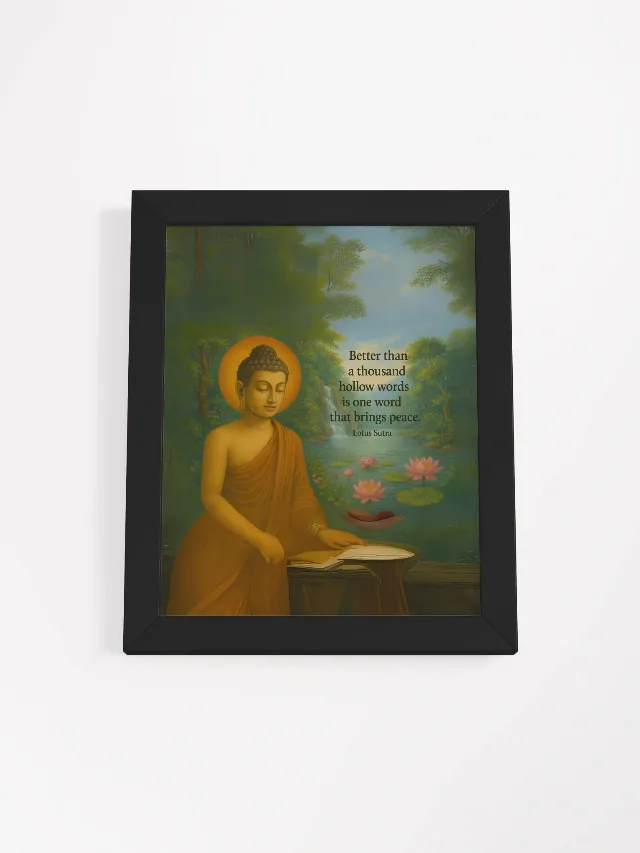
The Lotus Sutra matters because it says every person can become a buddha (an awakened person), and that this world is where it happens. Nichiren took that claim literally and built his teaching around it. The sutra is not a rulebook. It is a set of stories and declarations that widen what a human being can be.
The Lotus Sutra is one of the great Buddhist scriptures of East Asia, a text of twenty-eight chapters. It was translated into Chinese in the early fifth century and became one of the most copied, recited and commented-on texts of the tradition. The Lotus Sutra is not a history book or a set of commandments. It is a religious poem with parables, cosmic scenes and long speeches.
You do not need to read it from cover to cover to understand why Nichiren cared about it. Most practitioners meet it in pieces: a parable, a chapter, a line that stays with them.
The guide to the Lotus Sutra gives the wider picture. Here the question is narrower: what does the sutra actually claim, and why would someone organise a life around it?
It helps to know what kind of book you are holding. The sutra is not a systematic philosophy. It is a devotional and rhetorical text, full of repetition, exaggeration and scenes that defy ordinary time and space. Read it the way you would read a poem or a scripture, not the way you would read a manual. The repetitions are part of the method. They wear a groove in the mind.
One vehicle, no one left out
The most famous teaching of the sutra is the one vehicle. Earlier Buddhist teaching spoke of three paths: the voice-hearer (who awakens by listening to teaching), the cause-awakened one (who awakens through insight into cause and effect) and the bodhisattva (who works for the awakening of others). The Lotus Sutra says these are provisional. There is really one vehicle, the buddha vehicle, and it is open to all.
The sutra makes the point with a story. A house is on fire. The children inside are absorbed in their games and will not come out. Their father promises them three kinds of cart to lure them into the street. Once they are safe, he gives them all the same great carriage.
The three carts are the provisional paths. The great carriage is the one vehicle. The point is not that the father lied. The point is that he used what the children could understand to bring them somewhere better.
For Nichiren, this was the ground of his confidence that ordinary people could awaken. If the one vehicle is real, then no one is excluded by birth, education or capacity.
The Buddha's life is not limited
The sixteenth chapter, the Life Span chapter, changes the picture again. The Buddha reveals that he did not attain enlightenment for the first time in his historical life. He has been enlightened for an immeasurable span, and his life is still present.
This is not a claim about a physical body living forever. It is a claim about the nature of enlightenment. Awakening is not a past event that happened to someone else and left a memory behind. It is a living reality, available now.
The chapter is one of the most important in the sutra, and many practitioners recite part of it daily. The Life Span Chapter explains it in more detail.
The outsider becomes a buddha
Two figures in the sutra make the universal claim concrete.
The first is Devadatta, the Buddha's cousin, who in the stories is remembered as an opponent and a troublemaker. The sutra predicts that even he will become a buddha. That is a startling move. It says that no one is outside the reach of the teaching.
The second is the daughter of a dragon king, a child who is described as attaining buddhahood. She is young, female and not human, three reasons in the culture of the time for her to be excluded. The sutra includes her anyway.
These stories are not sentimental. They are arguments. They say that the boundary you think is fixed is not fixed. That is why the sutra has been read as a source of hope by people who were told they did not belong.
The stories also have a cost. If the dragon king's daughter can become a buddha, then the categories you use to sort people are less reliable than you thought. The sutra does not just add an exception. It questions the rule.
Why Nichiren built a practice on it
Nichiren did not treat the Lotus Sutra as one interesting text among many. He treated it as the teaching for the Latter Day of the Law, the age in which he believed he lived. Why the Lotus Sutra matters for this age is the historical question, but the practical one is simpler.
He wanted a practice that an ordinary person could do. The sutra's title became that practice: Nam Myoho Renge Kyo. The title contains the whole text, the way a title contains a book. Chanting it is not a summary of reading. It is a way of entering the sutra with your body and voice.
This is why the practice is so portable. You do not need to carry a library. You need the phrase.
How to read it without a teacher
Start with the parables. The burning house, the poor son, the jewel in the robe, the good medicine. They are designed to be understood by people who are not scholars. Read one slowly and ask what it says about you.
Use a translation you can actually read. There are several good modern ones. Do not begin with the most archaic.
Read a chapter at a time, and do not try to finish. The sutra rewards returning. A passage that seemed dull at twenty can be devastating at fifty.
It also helps to read with a question. "Who is being excluded in this story?" "What does this say about my own capacity?" "Where am I the child in the burning house?" A question turns reading into practice.
What it asks of you
The Lotus Sutra is not only a promise. It is a demand.
If every person can become a buddha, then you cannot write anyone off. Not the colleague who undermines you, not the relative who mocks your practice, not the person you have decided is beyond hope. That is a hard teaching, and it is meant to be.
It also asks you to include yourself. The one vehicle is not for other people who are calmer and better qualified. It is for the person reading this, with the life they actually have.
Try this today. Read one parable from the Lotus Sutra, even a short version. Then write one sentence about who you have been writing off, including yourself. Chant for five minutes before or after.
From Nichiren's writings. In On the Treasure Tower, Nichiren explains that the tower of treasures is not a building in a distant land. It stands in the life of the person who holds the Lotus Sutra. The sutra's grandeur is not elsewhere. It is in an ordinary life that has taken the teaching seriously.
Next step
The Expedient Means Chapter is the best place to begin reading the sutra itself.
The Life Span Chapter explains the chapter that reshaped how Buddhists understood the Buddha's life.
The Bodhisattvas of the Earth introduces the figures who appear in the sutra's second half and take up its practice.
When you are ready to practise rather than read, set the chant timer for five minutes. The title is the door.