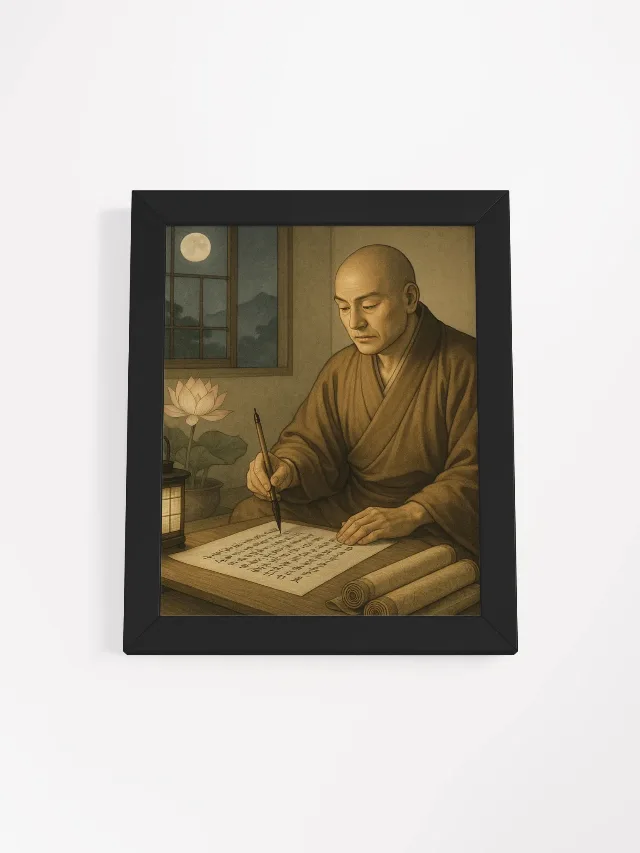
The Real Aspect of the Gohonzon is about what you see when you face your altar. Nichiren explains that the Gohonzon, the object of devotion, is not a picture of a power outside you. It is a representation of the awakened life, set down so that ordinary people can trust what they cannot yet see in themselves.
Nichimyo's visit, and the letter that followed
The letter was sent to Nichimyo, a woman who had travelled a long way to Sado to see Nichiren during his exile, with her young daughter. That trip was not a casual visit. It cost her time, money and considerable courage.
Nichiren remembered it. Years later he sent her a Gohonzon and wrote this letter to explain what she had received. It is traditionally dated to 1277.
The letter has a warmth that comes from a real relationship. He is not lecturing an audience. He is answering a woman who had already shown, by the distance she had come, that she understood something about devotion.
What "real aspect" means
The title is not asking whether the scroll is well made. "Real aspect" refers to the true nature of the thing, the reality it points to rather than its surface appearance.
A photograph of a person is not the person. But if you love the person, the photograph matters. It carries their absence and their presence at the same time.
The Gohonzon works like that, only in the other direction. It is not a portrait of someone far away. It is a portrait of what you are capable of becoming, drawn in a way that includes every ordinary state of life.
Nichiren's point is that the reality behind the symbol is not elsewhere. It is in the life of the person who bows.
A mirror, not a magic object
There is an old habit in religion of treating a sacred object as a lever. Say the right words, make the right offering, and the power behind the object will do what you ask.
This letter rules that out. The Gohonzon is not a lever. It is a mirror.
That does not make it unimportant. Mirrors are how we see ourselves. A person who has been told all their life that they are worthless may need a mirror that tells a different story, and may need to stand in front of it for a long time before they believe it.
The respect shown to the object is respect for what it represents. Bow because attention matters. Keep the space clean because your mind notices. Offer water because it is a small act of care in a life that is often careless.
The treasure tower is your body
One of the images behind this letter is the treasure tower from the Lotus Sutra, a jewelled structure that rises from the earth. Nichiren reads it as a picture of a human life that upholds the Law.
The tower is not a building. It is not a place you travel to. It is the dignity of the person who practises, and that dignity is not added from outside. It is revealed.
If you have ever felt that your body was an obstacle to spiritual life, too tired, too awkward, too ordinary, this is the part to sit with. The letter does not say the body is unimportant. It says the body is where the treasure is.
The room you practise in
There is a practical question tucked inside this letter. What kind of space do you make for practice, and what does that space say to you?
You do not need a special room. Most people do not have one. A corner of a bedroom, a shelf, a folded cloth on a table. The point is that the space is not accidental.
When you set something aside for practice, you are telling yourself that practice has a place in your life. That is why the small acts of care matter. The clean cloth, the fresh water, the flower that is slightly past its best.
The care you bring to a small corner is not decoration. It is a statement of intent, and it does not require anyone's permission.
Nichimyo's gift to Nichiren was the cost of getting to Sado. Yours may be a shelf and five quiet minutes. The letter treats both as real.
Why the recipient matters
Nichimyo was a woman in a society that gave women little public standing. Her devotion was real, and her options were limited. A letter that tells her the treasure tower is her own body is doing something more than explaining doctrine.
It is restoring dignity. It says that the awakening you are looking for is not reserved for people with better credentials, better connections or a better room to practise in.
That message travels. Whatever your circumstances, the letter places the possibility of awakening inside the life you actually have, not in a life you are still trying to earn.
The letter holds two things together that are often separated. It treats the Gohonzon with reverence, and it refuses to make it a magic object.
You can bring both attitudes to your practice. Light a candle. Bow. Chant with your whole attention. And do not spend a moment wondering whether the object is pleased with you.
The measure of the practice is not what happens on the altar. It is what happens in the kitchen, the office and the difficult conversation. The mirror is there to send you back into your life with a straighter back.
How to apply it today
Approach your practice as a relationship with your own potential. Before you chant, take one breath and let yourself arrive. Do not begin with a list of failures.
If your altar has become cluttered or neglected, spend ten minutes on it. Not because the object is offended, but because the care is a form of attention.
If you have no Gohonzon, use what you have. A window, a plant, a candle. The letter's logic does not depend on a particular object. It depends on what you are willing to see in yourself.
And when you feel nothing, keep the appointment. The mirror does not require a dramatic response. It only requires that you show up.
Try this today. Stand in front of your altar, or a mirror if you have no altar, and say quietly: "This life is the treasure tower." Then chant for five minutes. Notice how difficult or easy it is to say that sentence and mean it.
Reflection questions
- What do you see when you face your altar, and what do you avoid seeing?
- Where have you treated your body as an obstacle to practice rather than the place of it?
- How would you practise differently if you believed nothing needed to be added to you?
From Nichiren's writings. In The Real Aspect of the Gohonzon, Nichiren explains to Nichimyo that the object of devotion is not a distant deity but a mirror of the Buddha nature in her own life. What she reveres is the possibility of awakening that her ordinary body and mind already carry.
Next step
What the Gohonzon represents takes the symbolism apart piece by piece. Can I chant without a Gohonzon answers the question many beginners are afraid to ask. And setting up a simple altar helps you make a space that supports attention without costing a fortune.
For a first session, try the chant timer. Five minutes is a real beginning.