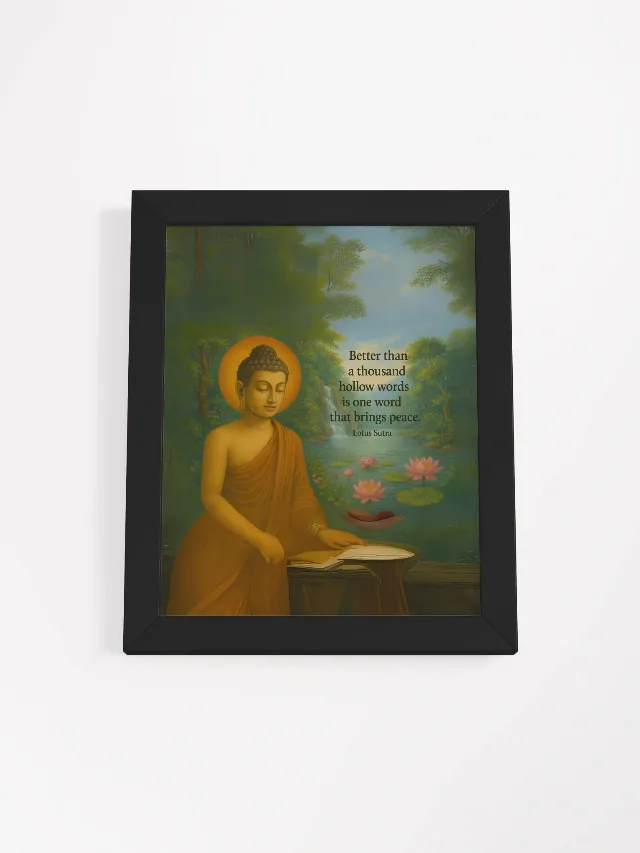
Gongyo is the recitation part of daily practice. It usually means reading two portions of the Lotus Sutra, the Expedient Means chapter and part of the Life Span chapter, then chanting Nam Myoho Renge Kyo. It takes less time than people expect, and it can be learned a line at a time.
What is gongyo?
The word means something like "assiduous practice": the part you do steadily, whether or not you feel inspired. In daily use it refers to a short service of sutra recitation, usually followed by daimoku, the chanting of the title.
It is not a performance, and nobody is marking it. The point is to give the chant a shape: a text that reminds you what you are doing, a beginning, an ending, and a reason to sit down at the same time tomorrow.
Some people chant daimoku alone for years and never take up gongyo. That is a complete practice. Others find that the recitation steadies them, especially on days when the mind is too restless to settle into the chant straight away. Both are ordinary.
The daily form has changed over centuries and differs between communities. What has not changed is the pairing: a passage of sutra, read aloud, and the title, chanted. Everything else is local custom.
Is gongyo the same as chanting?
No, though the two are usually done together. Chanting is the repeated title. Gongyo is the recitation of sutra passages that frames it. Think of the difference between a song and the short reading that comes before it.
Which parts of the Lotus Sutra are recited, and why?
A common form uses two chapters of the Lotus Sutra, the scripture at the centre of Nichiren's teaching. The second chapter is Expedient Means, and the sixteenth is Life Span. From the Life Span chapter, many formats recite the verses near the end, known as the jigage.
Why the Expedient Means chapter?
The second chapter is where the Lotus Sutra sets out its central claim: the teachings are many, but they lead to one vehicle, and every person can reach the same awakening. The Buddha explains that he has used stories and comparisons because a direct statement would not have landed. The chapter is about method, and about patience with the people being taught.
Reciting it is a reminder that the practice is not a test you can fail. The teaching bends towards the person, not the other way around.
Why the Life Span chapter?
The sixteenth chapter changes the picture. The Buddha reveals that his awakening was not a single event in a single life. His life is immeasurable, and the chapter changes the scale on which a human life is measured. The verses are the part most often recited, and they carry the chapter's argument in a form that is easy to say aloud.
Put simply: one chapter opens the door, and the other shows you the depth of the room you have walked into.
What about the rest of the sutra?
The Lotus Sutra has twenty-eight chapters. The two used in gongyo are not the whole of it, and they are not a summary of the rest. They are chosen because they carry the sutra's central turn: the promise that all beings can awaken, and the revelation that the Buddha's life is not bounded by one lifetime.
Reading the whole sutra in translation is a good thing to do slowly, over months. It is not required for the recitation, and you do not need to finish it before you begin. The Lotus Sutra guide is the place to start.
Do all communities read the same passages?
No. Formats vary. Some use a longer form, with more of each chapter. Some use a shorter one, with a single paragraph and the verses. The number of repetitions differs, and so do the opening and closing passages.
What is consistent in Nichiren's writings is the place of the Lotus Sutra at the centre of practice. The exact shape of the service is a local matter. This answer goes further if you want the detail.
What does a session look like, start to finish?
A simple session has five movements. The details vary, but the shape is stable.
- Prepare the space. Clear the table. Set out the text, a glass of water, a candle if you use one. Wash your hands if that helps you mark the transition.
- Open with a bell. One strike, then a breath. In some formats there is a short opening passage.
- Recite. Read at a steady pace, aloud, with your eyes on the page. Do not rush to finish. The sound matters as much as the sense.
- Chant daimoku. When the recitation ends, begin Nam Myoho Renge Kyo. This is usually the longest part of the session.
- Close. A final bell, and in some formats a short passage or silent prayers. Then sit still for one breath before you get up.
Posture matters less than you think, but a little care helps. Sit with your back upright and your feet flat. Put the text at eye level, on a table or a stand, so you are not folding your neck to read. A chair is fine. If you sit on the floor, use a cushion so your knees are lower than your hips.
In the common shorter form, the recitation runs to a few pages. Most of the time is the chant that follows it.
A short morning, written out
- 0:00 One bell. One breath.
- 0:10 First paragraph of the Expedient Means chapter, read aloud.
- 4:00 Daimoku.
- 9:00 One bell. One minute of quiet.
- 10:00 Stand up.
That is enough. The point is not to complete a text. The point is to begin the day with something that is not a screen.
If you have more time, add the verses of the Life Span chapter before daimoku. If you have less, read three lines and chant for two minutes. The shape holds at any length.
What if you have no bell?
Use a timer, a tap on the table, or nothing at all. The bell is a signal, and any signal will do. Some people begin by saying the date out loud, which sounds odd until you try it and find that it marks the transition better than you expected.
What are the silent prayers?
Some formats include a period of silent prayer after daimoku. The content differs between communities, and some formats do not include it at all. If you are practising alone, you can simply sit for a minute and name the people and situations you are holding. There is no requirement to fill the silence with words.
Can you do a shorter version?
Yes. One paragraph of the second chapter, followed by five minutes of daimoku, is a real session. On a difficult morning, that may be the whole of your practice, and it counts.
A short gongyo done regularly will teach you more than a full one done twice a year.
How do you learn gongyo without getting lost?
The text looks more intimidating than it is. It is repetitive in places, the lines are short, and the rhythm carries you once you have heard it a few times.
- Use a romanised text with line breaks. A dense block of Japanese characters is hard to track. A clean romanised page, with short lines, is much easier.
- Learn the first paragraph only. Not the chapter. The first paragraph. Read it aloud five times a day for a week.
- Follow a recording. Play it once and listen. Play it again and read along. Play it a third time and chant half a beat behind.
- Track with your finger. There is no prize for looking elegant. A finger or a pencil under the line keeps your place.
- Learn the ends of lines. Most people do not lose the start of a line. They lose the join between one line and the next. Practise the last two words and the first two words together.
- Read the translation once, outside the session. Knowing what a passage means helps it settle. Trying to translate while reciting does not.
Give it two months. Not because the text is difficult, but because the mouth needs repetition before the rhythm becomes automatic. How to learn gongyo step by step has a slower schedule if you want one.
What if you learn by ear?
Some people never read the text at all. They learn by following a recording until the sounds are familiar, the way a child learns a song. This works, and it is close to how the practice was carried for most of its history, when books were scarce and many people could not read.
If you learn by ear, keep a printed text nearby anyway. One day you will want to check a line, and it helps to know where you are. The ear gives you the rhythm. The page gives you the map.
How do you keep your place?
A bookmark, a folded corner, or a strip of paper under the current line. Some people copy the text by hand, which is slow but effective. If you lose your place mid-chapter, do not start again from the beginning. Find the line and continue.
Often, yes. A common pattern is a fuller recitation in the morning and a shorter one in the evening. Some people do the same both times. Some chant only daimoku at night, and save the recitation for the morning.
The morning session sets the direction of the day. The evening session puts the day down. Neither is more spiritual than the other.
If your evenings are unpredictable, make the morning session the fixed one and let the evening be optional. A practice with one reliable anchor lasts longer than a practice with two fragile ones. Morning and evening practice explains the pattern and how to bend it around a real schedule.
If you live with other people, the evening session is often the easier one to shorten. A short chant before bed disturbs no one and gives the day an end. The morning session can then be the one you protect.
When you travel, take the text with you. A copy on your phone is fine. If you cannot sit, chant quietly for five minutes and read one paragraph when you stop. A changed form is not a broken practice.
Do you need a bell, beads or an altar?
No. A text and a quiet place are enough.
A small bell marks the start and end and helps you keep a pace. A folded cloth under it softens the sound if you live close to other people. Prayer beads, juzu, give the hands somewhere to rest during daimoku. Neither is a requirement, and neither makes the practice more valid.
A butsudan is a home altar, usually a small shelf or cupboard with a scroll, a candle and a simple offering. It can make the corner of a room feel like a place to stop. It can also turn into a decorating project that delays the practice. Start with the text.
We are not affiliated with any organisation, school or temple. We respect and appreciate every community that helps people practise and that works for peace and the good of society. The guidance here is about the practice itself, and you should follow the form your own community teaches if you have one. Setting up a simple home altar covers the practical side.
What makes it difficult, and what helps?
"I keep losing my place"
Slow down. Most lost places are caused by reading faster than the eye can track. Put a finger under the line and read at the speed of speech, not the speed of thought.
"I do not understand the words"
That is normal for the first year, and it is not a barrier. The recitation is not an exam on meaning. Read a translation once a week, outside the session, and let the sense accumulate slowly.
"It feels like homework"
Then it is probably too long. Cut it to one paragraph and five minutes of daimoku. Attach it to something you already do: after the kettle boils, before you open your laptop, after you brush your teeth. A cue is more reliable than motivation.
"I miss days"
Begin again the next day. There is no backlog and no penance. A practice with gaps is still a practice. What to do when you miss a day has a longer answer.
"I feel nothing when I do it"
Many people do not feel anything for weeks, and some never feel a distinct sensation. The practice is not a mood-enhancer. On some mornings the silence afterwards will be flat. That is not a failure. It is a Tuesday. The value is in the return, not in the feeling.
"My family thinks I am talking to myself"
You probably are, in a sense. Explain it once, briefly, and then keep the volume reasonable. If the house is full, chant quietly or use a room with a door. Chanting in a shared home has practical suggestions.
How gongyo fits with daimoku and the rest of practice
Daimoku is the centre. Gongyo is the frame around it. Study is what you do afterwards, when you want to know what the frame is holding.
The three are usually described together as faith, practice and study: the trust that makes you sit down, the sitting down itself, and the reading that keeps the practice from becoming a habit you cannot explain. None of them is a substitute for the others. Faith, practice and study sets out the relationship.
If you only have ten minutes, chant. If you have twenty, recite one paragraph and then chant. If you have a free hour, do the full form and then read a page of the sutra in translation. The order is less important than the returning.
There is a temptation to treat gongyo as the serious part and daimoku as the warm-up, or the reverse. Neither is right. The recitation gives the chant a text to lean on. The chant gives the recitation somewhere to land. Done together, they keep each other honest.
Try this today. Open a romanised text at the first paragraph of the Expedient Means chapter. Read it aloud three times, slowly, with your finger under the line. Then chant Nam Myoho Renge Kyo for three minutes. Stop before you are tired.
From Nichiren's writings. In On the Treasure Tower, Nichiren turns to the moment in the Lotus Sutra when a jewelled tower rises from the ground and a Buddha inside it testifies to the teaching. He reads the scene as a statement about ordinary life: the treasure is not reserved for a distant place or a special person. Reciting the sutra is not admiring someone else's enlightenment from a safe distance.
Next step
If you have not chanted yet, start with how to chant Nam Myoho Renge Kyo. It covers posture, pronunciation and a first five minutes, with no text to learn.
If you want a slower lesson plan for the recitation, how to learn gongyo step by step breaks it into small pieces.
If your difficulty is fitting practice into a real week, morning and evening practice shows how other people shape the day.
You can also chant along with a video and let someone else keep the rhythm while you learn.