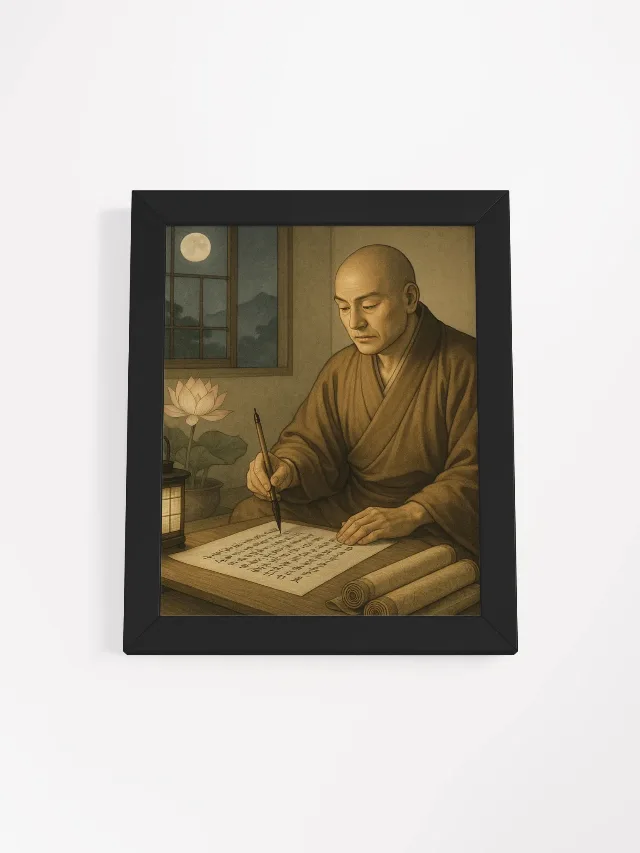
Reply to Kyo'o is a short letter to a sick child. Nichiren writes to the young daughter of one of his closest followers and refuses to treat her illness as a punishment or a verdict. He points her family towards the lion's roar of the daimoku, the chanting of Nam Myoho Renge Kyo, and towards steady, unpanicked care.
A child named Kyo'o
Kyo'o was the daughter of Shijo Kingo, a Kamakura samurai who had become one of Nichiren's most loyal followers. She was a small child when the letter was written, which makes the fact that it is addressed to her remarkable.
Nichiren does not write over her head to her parents. He writes to the child herself, in language a family could read aloud to her. That choice says something about how he saw children. They were not an unfinished category of person. They were people with a life of their own.
The letter is traditionally dated to 1273. Kyo'o was ill, and the household was frightened. Nichiren was in exile on Sado, unable to visit, and wrote instead.
Illness is not a punishment
This is the heart of the letter, and it is worth stating plainly. Being ill does not mean you have done something wrong. It does not mean your faith is weak. It does not mean the Law has turned away from you.
In Nichiren's time, illness was often read as a sign of moral or spiritual failure. Families carried shame as well as fear. The letter refuses that reading.
A child's sickness is not a verdict on the child or the parents. It is a hard fact in a world where bodies get ill. The letter does not explain why. It does not offer a neat reason. It sits with the family in the difficulty and points them towards practice.
That restraint is important. People in crisis are often given explanations that help the explainer feel better. The letter gives something else: company and a practice.
Parents are especially good at finding reasons to blame themselves. If I had noticed sooner. If I had fed her better. If I had been more faithful. The letter does not trade in those ifs. It turns the family towards what can be done now: chant, care, rest, ask for help. Guilt is not a form of love. It only feels like one.
The lion's roar
The image Nichiren uses for daimoku is a lion's roar. Not a whisper, not a polite request. A sound that makes other noises stop.
The image is not about volume. It is about confidence. When fear is talking loudly, the practice gives you a way to answer it that is not fear.
A lion's roar is also not aggression. The lion in the old stories does not roar to hurt anyone. It roars because that is what a lion does. The courage is natural to the creature.
The letter invites the family to find that natural courage. Not to pretend they are not afraid. To chant from the middle of the fear.
Children are not outside the Law
Some religious language treats children as not yet ready for serious practice. They are welcome to watch, to learn, to be blessed. The real business starts when they are older.
This letter does not take that view. Kyo'o is addressed directly. Her life is treated as a life that matters now, not a rehearsal for a later one.
That has implications for how families practise. A child can chant. A child can be told the truth in simple words. A child can be part of the household's practice rather than a spectator to it.
It also means a sick child is not a passive object of adult anxiety. She is a person with her own dignity, and the letter speaks to that dignity.
Fear is the second suffering
When someone we love is ill, the illness is not the only hard thing. There is also the fear, the waiting, the phone calls, the nights when you cannot sleep.
The letter does not separate the two. It speaks to the child and, through her, to the household. The chanting is for the whole room.
Fear is not a failure of faith. It is a human response to uncertainty. The practice does not remove it. It gives you somewhere to put it.
Many carers describe chanting as a way of steadying themselves before they walk back into the room. Not because it changes the diagnosis. Because it changes the person who has to face the diagnosis.
It can also give a frightened child something to do. A short chant, a familiar sound, a parent's voice. Children often understand ritual better than explanations. They know that something is being done, even if they cannot say what.
That is not a substitute for telling them the truth in words they can hold. It is another language for the same care.
Medicine and chanting belong together
Nichiren lived in a world without modern medicine, but he was not opposed to practical care. The letter does not tell the family to abandon what help was available.
That matters for anyone who has been told that faith and treatment are rivals. They are not. Chanting supports the person who is receiving care, and the people who are giving it.
If you are ill, take the medicine. Go to the appointment. Ask for help. Chant as well. The practice is not a replacement for the body's needs.
How to apply it today
If someone you love is unwell, chant for them. You do not need a special ritual. Say their name, or hold them in your mind, and chant.
Then do one practical thing. Bring water. Make the call. Sit with them. Let the practice flow into the care.
If you are the one who is ill, be gentle with yourself. You are not a problem to be solved. You are a person with a body that needs rest and a life that still matters.
And if you are a parent, remember that your fear is not the whole truth of the situation. Your child is not only a diagnosis. The letter sees a person. Try to see one too.
Try this today. If someone you love is unwell, chant for ten minutes today with their name in mind. Then do one practical thing for them: bring water, make a call, or sit with them without trying to fix anything.
Reflection questions
- Where have you been treating illness as a verdict on your faith or your character?
- What would it mean to chant from the middle of fear rather than waiting to feel brave?
- Who in your family needs to be spoken to directly, rather than talked about?
From Nichiren's writings. In Reply to Kyo'o, Nichiren writes to a sick child and her family not with a promise of a cure but with a refusal to let illness define her. He calls on the courage of faith, the lion's roar of the daimoku, and the steady care of the people around her.
A gentle note. Chanting can sit alongside professional care, but it is not a substitute for it. If you are in crisis or need someone to talk to, please reach out to a local helpline through findahelpline.com.
Next step
Can I chant lying down or when I am ill answers a practical question many sick people are embarrassed to ask. Can children chant is for parents who want to include their family. And chanting for someone else goes further into practice for the people we love.
If you need a place to begin, the chant timer works wherever you are.