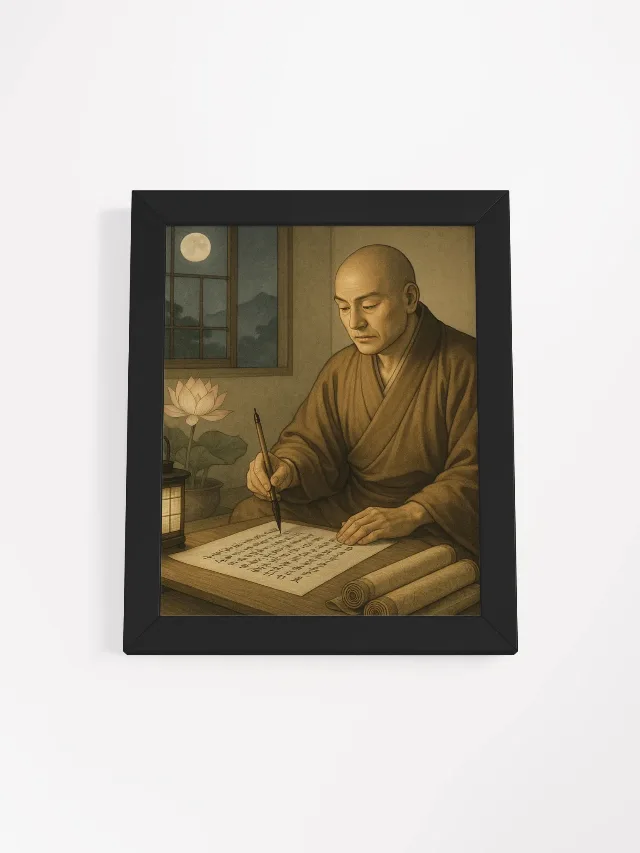
On Attaining Buddhahood in This Lifetime is one of Nichiren's shortest letters, and one of his most direct. He writes to a samurai supporter to say that Buddhahood is not a distant reward for unusually holy people. It is the potential already alive in an ordinary life, and chanting Nam Myoho Renge Kyo is how that potential is recognised.
Toki Jonin, and the question he asked
The letter went to Toki Jonin, a samurai official in Shimousa province who became one of Nichiren's most dependable supporters. Toki was not a monk. He had a household, local duties and a reputation to protect.
That matters for reading the letter. Nichiren is not writing to someone with empty hours for meditation. He is writing to a busy man with a family and a job, who wanted to know whether a serious practice could fit inside an ordinary life.
The letter is traditionally dated to 1255, early in Nichiren's teaching life and well before the persecutions that shaped his later years. It reads like an answer to a question Toki had put to him, the simplest question a practitioner can ask: is it really possible for someone like me?
Nichiren's answer is yes, but not in the way Toki might have expected. He does not promise that life will become easier. He turns Toki back towards his own mind.
Buddhahood is not somewhere else
Most of us carry an unspoken picture of enlightenment as a place. Somewhere cleaner and calmer, reserved for people who have given up more than we have.
This letter refuses that picture. Nichiren treats the Buddha nature as the ground of your life as it already is, not a substance added by a ceremony or a prize for good behaviour. Practice does not install it. Practice clears the way for you to see it.
That changes what chanting is for. You are not trying to reach a distant signal or persuade an outside power to notice you. You are learning to listen to something closer than your own thoughts.
It also changes how you measure progress. If Buddhahood were somewhere else, you could map the distance and worry about your pace. If it is already here, the question becomes whether you are paying attention.
All ten worlds share one moment
Nichiren uses the framework of the ten worlds, ten states of life that run from hell through hunger, anger and tranquillity to Buddhahood. The list is not the point. The point is that all ten are present in a single moment of life.
This has two consequences. A person in the deepest misery is not cut off from Buddhahood. And a person who has awakened still knows anger, envy and foolishness. Buddhahood is not the deletion of difficult states. It is the wisdom that can hold them without being owned by them.
If you have ever felt that a bad week disqualifies you from practice, this is the part to read twice. Nothing in your life falls outside the reach of the Law, the truth the Lotus Sutra points to.
Chanting is a way of looking at your mind
The Japanese word kanjin means observing the mind, and it sits behind much of Nichiren's teaching. It sounds technical. In practice it is ordinary. You sit down, you chant, and you notice what your mind does. It wanders. It argues. It makes a shopping list.
You bring it back. Then it wanders again.
The daimoku, the title of the Lotus Sutra chanted as Nam Myoho Renge Kyo, is not a password. It is a practice of attention and intention, repeated until it changes how you meet the rest of the day. Nichiren's confidence rests on the sutra's claim that all people can awaken, not on how impressive you feel while chanting.
So a flat, distracted five minutes is not a failed five minutes. You turned up. That is the whole of it.
Faith is trust, not certainty
Toki lived in a world of oaths, rank and obligation. Faith, in this letter, is not the same as certainty about doctrines. It is the decision to keep going before you have proof.
Nichiren does not ask Toki to pretend to believe more than he does. He asks him to act as though the Buddha nature in him is real, and to watch what happens over months rather than minutes. That is a more honest kind of faith than many of us were taught.
Doubt is allowed. It is not the opposite of practice. It is one of the things you bring to the cushion.
What the letter does not promise
It does not promise that chanting will make you calm, successful or liked. It does not say that difficulties vanish once you begin.
What it offers is a different starting point. Instead of waiting to become worthy, you begin from the claim that something worthy is already here. That claim is not a mood. It is a working hypothesis you test in ordinary days.
This is why the letter has lasted. It does not ask you to be extraordinary. It asks you to be honest about where you are, and to keep chanting from there.
How to apply it today
Begin with the life you actually have. If you have ten minutes before work, use them. If you have three, use three. The letter sets no minimum and asks you to become no one else before you start.
Then watch for the habit of deferring. You will practise properly when the children are older, when work calms down, when you have read more. This teaching cuts through all of that. This moment is the only one you have, and the Buddha nature is not waiting for a better version of you.
There is a caution too. Seeing your ordinary mind clearly can be uncomfortable. Be kind about what you find there. The aim is not to audit your flaws but to stop believing they are the whole story.
It also helps to tell someone. The letter was written to a person, not to a crowd. Toki had a relationship with Nichiren that could hold questions. If you can, find one person who will listen without trying to fix you, and say out loud what you are actually working with.
Try this today. Pick one ordinary task, such as washing up or walking to the bus, and do it slowly for two minutes while silently chanting Nam Myoho Renge Kyo. Afterwards, write one sentence about what you noticed.
Reflection questions
- Where have you been treating Buddhahood as something to earn rather than something already present?
- Which of the ten worlds visited you most often this week, and how did you respond when it arrived?
- If your ordinary mind really were the doorway to awakening, what would you stop postponing?
From Nichiren's writings. In On Attaining Buddhahood in This Lifetime, Nichiren tells Toki Jonin that enlightenment is not a distant destination or a reward for unusually holy people. The Buddha nature is already present in an ordinary person's life, and chanting the daimoku is how that hidden potential is recognised and put to use.
Next step
If you would like to begin, the guide to chanting covers posture, pronunciation and a first session. The ten worlds explains the map of states this letter assumes. And what Buddhahood means answers the question Toki was really asking.
You could start with five minutes on the chant timer. Nothing else is needed.