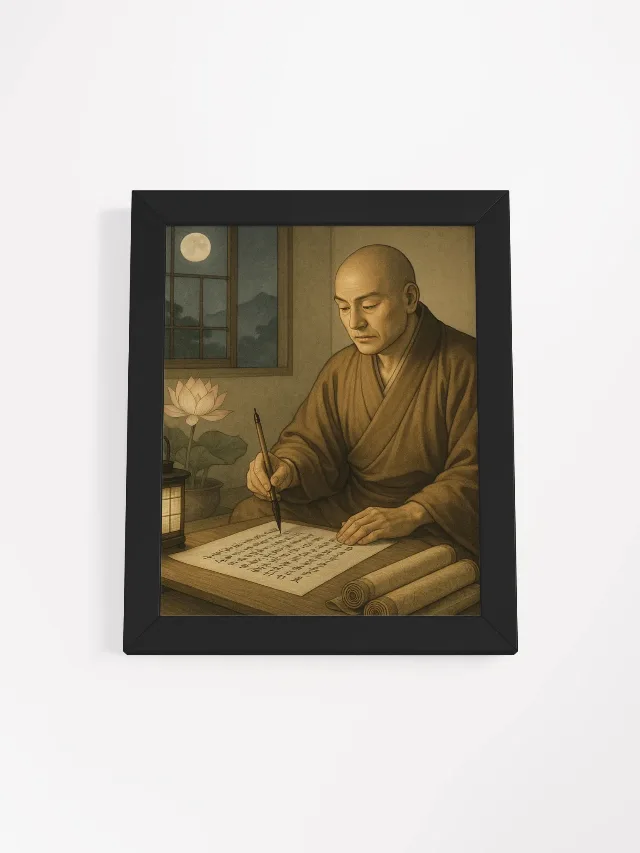
The Object of Devotion for Observing the Mind explains what a practitioner actually relies on. Nichiren argues that the object of devotion is not a distant power to be appeased. It is a mirror of the awakened life, set down so that ordinary people can see and trust what they cannot yet see in themselves.
Toki Jonin's question, and the answer from Sado
Nichiren wrote this treatise on Sado in 1273, during his exile, and sent it to Toki Jonin. Toki was a samurai official who had supported him for years and who, like many followers, wanted to know what exactly he should be focusing on.
The question was practical. People who chant need something to face. An altar, a scroll, a physical point of attention. Nichiren had taught that the Law is present in life itself, so what should a practitioner place in front of them?
His answer became one of the most important writings in this tradition. It sets out the Gohonzon, the object of devotion, and the practice of observing the mind. It is dense in places, but the core is simple enough to hold in one hand.
What an object of devotion is for
Human beings are physical. We think with our eyes as much as with our ideas. A wedding ring, a photograph, a flag, a gravestone: these objects carry meaning that words alone cannot hold.
An object of devotion works in the same way. It gives your attention somewhere to rest. When you sit down in the morning, tired and half-awake, you do not have to reconstruct a whole philosophy from scratch. You face the Gohonzon and begin.
That is not superstition. It is how attention works. The question is what the object points to.
The mirror, not the idol
Nichiren is emphatic that the object of devotion is not a god who lives outside you and must be persuaded to help. The Gohonzon represents the awakened life, the condition of Buddhahood, and it does so in a form that includes ordinary people.
Think of a mirror. A mirror does not give you a face. It shows you the face you already have. The Gohonzon functions like that. It shows you the dignity your life already carries, and it keeps showing you until you can believe it.
This is why the tradition treats the object with respect without making it a fetish. You bow, you offer water, you keep the space clean. The care is for your own attention as much as for the object.
Observing the mind is ordinary work
The phrase "observing the mind" sounds like something a monk would do in a cave. In practice it is closer to noticing.
You sit down to chant. Within a minute you are replaying a conversation from yesterday. You plan a shopping list. You argue with someone who is not in the room. That is not a malfunction. That is the mind doing what minds do.
Observing the mind means you notice this without turning it into a drama. You see the worry, the fantasy, the resentment. You bring your attention back to the chant. Then you do it again.
Over time, the noticing starts to happen outside the practice too. You catch yourself before sending the angry message. You notice that you are tired before you snap at someone. That is the practice working.
One moment contains a whole world
The treatise draws on the principle of three thousand realms in a single moment of life. It is a large idea with a simple heart. Every moment of your life contains the whole of your world: your body, your surroundings, your relationships, your history.
This is not a slogan about positive thinking. It means that the way you meet one moment shapes the world you live in. A moment of generosity changes the room. A moment of contempt does too.
It also means you do not have to fix everything at once. You cannot. You can meet this moment with attention. That is the whole of the practice, repeated.
Person and Law are not two
Another theme in the treatise is the relationship between the person who awakens and the truth they awaken to. Nichiren refuses to separate them. The Law is not a cold abstraction floating above life. It appears in a person. And a person is not an isolated hero. They are held by the Law.
For a practitioner, this dissolves a familiar worry. You do not have to become impressive before the teaching works. The teaching is already at work in the ordinary person you are.
It also protects you from guru-worship. The person matters. The Law matters more. A healthy practice keeps both in view.
People sometimes assume that because the Gohonzon is a physical object, the practice is about persuading it. Chant enough, bow correctly, keep the altar tidy, and the object will relent and give you what you want.
Nichiren's explanation rules that out. The object does not have a mood to manage. It is not keeping score. What changes is the person who keeps showing up.
There is a second misunderstanding on the other side. If the Gohonzon is only a symbol, why bother with it at all? Why not chant anywhere, in any posture, with no altar?
You can chant anywhere. But symbols do work on us, and refusing all of them does not make us free of them. The question is whether the symbol you use points towards your own dignity or away from it. A well-kept altar, used without superstition, points towards it.
How to apply it today
If you have a Gohonzon, treat your time in front of it as a relationship rather than a transaction. Bow, chant, and be honest about what you are carrying. Do not perform a mood you do not have.
If you do not have one, none of this is closed to you. Face a wall, a window or a candle. The point is attention, not furniture. You can begin today with the guide to chanting.
Keep the space simple. A small shelf, a glass of water, a flower if you have one. Clean it now and then. The cleaning is part of the practice.
And when you notice nothing special happening, stay. The mirror does not stop working because you are bored.
Try this today. Before you chant, say quietly: "This life is where the Law appears." Then chant for five minutes, letting that sentence sit underneath the words. Write one line afterwards about what you noticed.
Reflection questions
- What have you been treating as an object of devotion without realising it, and what has it been showing you?
- When your mind wanders during chanting, what is it usually trying to protect?
- How would your practice change if you believed the Law was already at work in your ordinary life?
From Nichiren's writings. In The Object of Devotion for Observing the Mind, Nichiren explains that the object of devotion is not an outside power to be appeased. It is a representation of the awakened life that already exists in the practitioner, set down so that ordinary people can see it, trust it and live from it.
Next step
The Gohonzon is the full guide to what the object of devotion is and how to relate to it. What the Gohonzon represents goes deeper into the symbolism. And chanting before you have a Gohonzon is for anyone who wants to start without waiting for an altar.
You can begin with five quiet minutes on the chant timer, wherever you are.