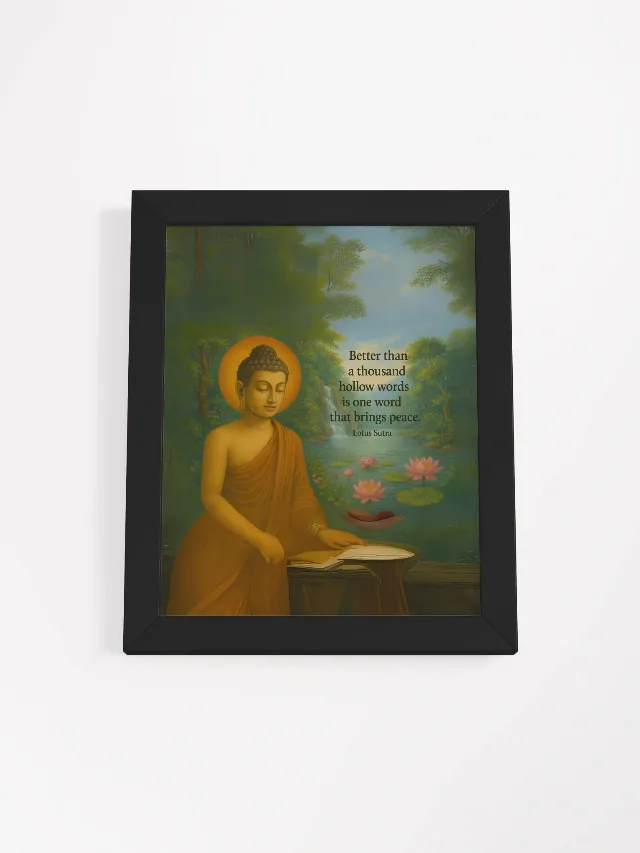
The Lotus Sutra is a Mahayana Buddhist scripture, probably composed in India in the early centuries of the Common Era. It teaches that all people can become buddhas, that the Buddha's life is immeasurable, and that many methods lead to one truth. Nichiren built his entire practice on it.
What is the Lotus Sutra?
A sutra is a Buddhist scripture, traditionally presented as a teaching of the Buddha. This one is among the most influential in East Asia. Its Sanskrit title, Saddharma Pundarika Sutra, means something like "the white lotus of the wonderful law". The lotus is a useful image: it grows in mud and opens above the water. The sutra is not asking you to leave the mess of ordinary life. It is asking you to bloom in it. The glossary entry gives the short definition.
The text was composed in India and grew over time. Scholars date its composition to the early centuries of the Common Era. Tradition presents it as Shakyamuni's teaching, delivered late in his life. Both views are held by people who study it seriously, and you do not have to settle the question before you read.
It reached China and was translated by Kumarajiva's team in 406. That Chinese translation, later expanded to 28 chapters, became the standard text across East Asia. It is the version Nichiren read, quoted and argued from. If you pick up an English translation today, it is almost certainly based on that version.
The sutra is not a history book or a systematic philosophy. It is a dramatic text: vast assemblies, parables, a jewelled tower rising from the earth, a Buddha who has been enlightened for an inconceivably long time. It was written to be heard and performed as much as read.
What are its central teachings?
Four ideas hold the sutra together.
One vehicle. The Buddha's earlier teaching described three paths: the voice-hearer, the cause-awakened one and the bodhisattva. The Lotus Sutra says those three were skillful means. There is really one vehicle, the buddha vehicle, and it carries everyone. The destination is not reserved for monks or specialists. The Expedient Means chapter is where the claim is made.
Skillful means. The Japanese word is hoben. It means that a teacher adapts the message to the listener. A doctor gives a child a different dose from an adult. The truth does not change; the way it is offered does. The Lotus Sutra uses parables to show this, and then says that the parables themselves are part of the teaching.
The Buddha's life is immeasurable. In chapter 16, the Buddha reveals that he did not simply appear in the world, teach, and disappear. His life is far longer than the span people assumed. He is still present, still teaching. The Life Span chapter is the heart of this teaching.
Universal buddhahood. Everyone can awaken. The sutra does not just state this. It dramatises it with people the assembly did not expect: a cousin who tried to kill him, an eight-year-old girl, a wandering monk who was mocked for bowing to strangers. The claim is that buddha nature is not a prize for the well born or the well trained.
Many readers take these ideas to mean that awakening is not somewhere else. The assembly in the sutra happens in this world. The treasure tower rises here. The bodhisattvas emerge from this ground. You do not have to leave your life to find the teaching. You have to learn to see it where you are.
The parables that carry the teaching
The sutra is famous for its stories. Six of them do most of the work.
The burning house (chapter 3). A wealthy man's house catches fire. His children are inside, absorbed in play, and will not come out when he calls. He promises them three carts, drawn by goats, deer and oxen, if they come into the yard. They run out. Instead of three carts, he gives them all one great white ox cart, finer than anything they were promised. The three carts are the three paths. The one cart is the one vehicle. The father is not lying. He is doing what a parent does when the house is on fire.
The lost son (chapter 4). A young man runs away from home and forgets who his father is. Years later, destitute, he drifts back to the family estate. His father recognises him, but the son is too frightened to accept the truth. So the father hires him as a labourer, gives him small responsibilities, and gradually lets him grow into the inheritance. The son does not become someone else. He discovers what he already was.
The medicinal herbs (chapter 5). Rain falls equally on all plants. Each plant takes what it needs according to its roots, leaves and capacity. The teaching is one; the reception is different. Nobody is left out of the rain.
The jewel in the robe (chapter 8). A man gets drunk at a friend's house and falls asleep. The friend sews a priceless jewel into the hem of his robe. The man wakes, forgets the jewel, and spends years wandering in poverty. The treasure was with him the whole time. He did not know how to look.
The phantom city (chapter 7). A guide leads a group of travellers towards a treasure. They are exhausted and want to turn back. The guide conjures a city where they can rest. Once they are rested, he tells them the city was an illusion and leads them on to the real destination. Provisional teachings are rest stops, not the end of the road.
The excellent physician (chapter 16). A doctor's sons drink poison. Some are so deranged that they refuse the medicine. The father travels away and sends word that he has died. In their grief, the sons take the medicine and recover. The father returns. The Buddha's apparent absence is a skillful means, not an abandonment.
You do not need to decode every symbol to feel these stories. They work on a child and on a scholar. That is why they have lasted.
The 28 chapters at a glance
The standard East Asian version has 28 chapters. You do not need to read them in order, and you do not need to remember every name in the lists. This is a map, not a test.
Chapters 1 to 14
- 1. Introduction: The assembly gathers; the Buddha emits a ray of light.
- 2. Expedient Means: The Buddha declares one vehicle; the three are skillful means.
- 3. Simile and Parable: The burning house; a father lures his children out with carts.
- 4. Belief and Understanding: The lost son; disciples learn that they are heirs.
- 5. The Parable of the Medicinal Herbs: Rain falls on all plants; each takes what it needs.
- 6. Bestowal of Prophecy: The Buddha predicts buddhahood for leading disciples.
- 7. The Parable of the Phantom City: A conjured city gives weary travellers rest on the way.
- 8. Prophecy of Enlightenment for Five Hundred Disciples: A jewel is sewn into a sleeping friend's robe.
- 9. Prophecies Conferred on Learners and Adepts: Further predictions of buddhahood.
- 10. The Teacher of the Law: The merit of teaching and copying the sutra.
- 11. The Appearance of the Treasure Tower: A jewelled tower rises; Many Treasures Buddha attests.
- 12. Devadatta: Devadatta is predicted to become a buddha; a dragon king's daughter awakens.
- 13. Encouraging Devotion: The Buddha urges the assembly to keep and teach the sutra.
- 14. Peaceful Practices: How to teach the sutra with patience and humility.
Chapters 15 to 28
- 15. Emerging from the Earth: The Bodhisattvas of the Earth emerge, led by Superior Practices.
- 16. The Life Span of the Thus Come One: The Buddha reveals that his life is immeasurable.
- 17. Distinctions in Benefits: The benefits of hearing and accepting the teaching.
- 18. The Benefits of Joyful Acceptance: The joy of receiving the teaching.
- 19. The Benefits of the Teacher of the Law: The benefits of teaching the sutra.
- 20. The Bodhisattva Never Disparaging: Never Disparaging bows to everyone he meets.
- 21. The Supernatural Powers of the Thus Come One: The Buddha displays his supernatural powers.
- 22. Entrustment: The teaching is handed to the bodhisattvas.
- 23. The Former Affairs of the Bodhisattva Medicine King: The devotion of the Bodhisattva Medicine King.
- 24. The Bodhisattva Wonderful Sound: A bodhisattva from another world comes to hear the sutra.
- 25. The Universal Gateway of the Bodhisattva Perceiver of the World's Sounds: The bodhisattva of compassion hears cries and appears in many forms.
- 26. Dharani: Protective spells for those who keep the sutra.
- 27. The Previous Life of King Wonderful Adornment: A king is led to the teaching by his sons.
- 28. The Encouragement of the Bodhisattva Universal Worthy: Universal Worthy promises to protect practitioners.
The first fourteen chapters are often called the trace teaching. They show the Buddha teaching in the world, using parables and predictions. The second fourteen are the origin teaching. They reveal the depth of his life and entrust the sutra to the Bodhisattvas of the Earth. Chapter 2 and chapter 16 are the two hinges on which the whole text turns. Why the Lotus Sutra Matters explains that structure in more detail.
A tower, a girl and a bodhisattva who bowed
A few stories from the sutra are worth knowing even if you never read the whole thing.
The treasure tower (chapter 11). A vast tower made of seven kinds of treasure rises out of the earth and stands in the air. Inside is Many Treasures Buddha, a buddha from the distant past who vowed to appear wherever the Lotus Sutra was taught. He has come to confirm that the teaching is true. The Buddha opens the tower, sits beside him, and the whole assembly is lifted into the sky. The scene is the origin of the Ceremony in the Air, the image at the heart of the Gohonzon. The Treasure Tower and the Ceremony in the Air walks through it.
The dragon king's daughter (chapter 12). An eight-year-old girl appears before the assembly. She is young, she is female, and she is not human. The assembly has doubts about whether someone like her can awaken. She attains buddhahood on the spot. The story has been read in many ways over the centuries. What the sutra makes visible is simple: the people the assembly expected to be excluded are not excluded.
Never Disparaging (chapter 20). A monk bows to everyone he meets and says, in effect, that they will become a buddha. Some people are furious. They throw stones, sticks and dirt at him. He keeps bowing, sometimes from a distance, and he never stops saying it. The story is not advice to let people hurt you. It is a portrait of a practice: seeing the buddha nature in someone who is not behaving well, without pretending that the behaviour is fine.
The Bodhisattvas of the Earth (chapter 15) are the fourth great image. They emerge from the ground, led by Superior Practices, and the Buddha entrusts them with the sutra. They are not visitors from another world. They come from this one. Many readers see in them a picture of ordinary people carrying the teaching in ordinary life. Who Are the Bodhisattvas of the Earth? explores the story.
Why Nichiren built his practice on it
Nichiren read the Lotus Sutra as the fullest teaching of the Buddha. For him, this was not a matter of taste among books. He believed the sutra made a claim the earlier teachings did not: that every person, without exception, could awaken in this life. If that was true, then the practice had to be shaped around it.
He took the title as the practice. The daimoku, Nam Myoho Renge Kyo, is the title of the sutra. Chanting it is a way of entering the whole text without needing to master Chinese, memorise 28 chapters, or spend years in a monastery. The meaning of the chant explains each word.
He also read his own persecutions through the sutra. The text predicts that those who teach it will face hostility. When he was exiled and attacked, he did not see that as evidence that he had been abandoned. He saw it as a way of reading the sutra with his body: not just studying its words, but living the difficulties it described. That idea is explained in What the Persecutions Teach Us.
He wrote The Opening of the Eyes to set out why he had staked his life on this. He did not ask people to worship the book. He asked them to practise its title and see what changed in their lives. The Gosho study is a good place to read that argument for yourself.
How the sutra appears in daily practice
If you have heard a Nichiren practice, you have already heard the sutra.
In many communities, morning and evening gongyo includes a passage from chapter 2, the Expedient Means chapter, and the verse section of chapter 16, the Life Span chapter. That verse section is called the jigage. Some people recite in Japanese, some in English, some in a mixture. The length and format vary between communities, and that is normal. Gongyo explains the structure, and how to learn it takes it step by step.
The recitation is not a magic formula. It is a way of putting the sutra's words in your mouth, so that its claims about life become familiar. You may not understand every line at first. Most people do not. The sound and rhythm carry you until the meaning catches up.
The daimoku is the heart of the practice. The recitation supports it. If you are busy, a short passage is enough. If you are curious, read the chapter the passage comes from. The two habits feed each other. Which parts of the sutra are recited, and why answers the practical questions.
How to start reading it
Choose a modern translation and read the introduction. It will tell you which version you have and what the translator has done.
Then start with chapters 2, 3, 16, 20 and 25. Chapter 2 gives you the core argument. Chapter 3 gives you the burning house. Chapter 16 gives you the Buddha's immeasurable life. Chapter 20 gives you Never Disparaging. Chapter 25 gives you the bodhisattva of compassion. That is a good short course in the sutra.
Read aloud when you can. The text was oral, and it behaves differently in the mouth than on the page. Give each parable time. Do not race to the end.
Do not force yourself through the long lists of names and attendants. Skim them. They are part of the music, not a quiz. You can come back when you know the story better.
Keep a notebook. Write one line per chapter: what you noticed, what annoyed you, what you want to ask someone. Read with a friend or a study group if you can. The sutra is full of arguments, and arguments are better with company.
It is fine to read it as literature first and as scripture later. It is also fine to do the reverse. There is no correct order, only the one that keeps you reading.
Try this today. Read the parable of the burning house in chapter 3, aloud if you can. It takes about ten minutes. Then write one sentence about which cart you have been hoping for.
From Nichiren's writings. In The Opening of the Eyes, Nichiren explains why he staked his life on the Lotus Sutra. He argues that the sutra is the teaching for a time of confusion, and that he would rather be its witness than be safe and silent.
Next step
If you want the big picture before you start, read Why the Lotus Sutra Matters. It explains why a text from the first centuries of the Common Era still shapes a daily practice.
When you are ready for the central argument, The Expedient Means Chapter takes you through chapter 2 slowly. It is the hinge of the whole sutra.
For the teaching that changes how people chant, The Life Span Chapter looks at chapter 16 and the verses many communities recite each day.
If you learn better by listening, the video library has recordings of the chant and the recitation. Start with a short one and follow along.