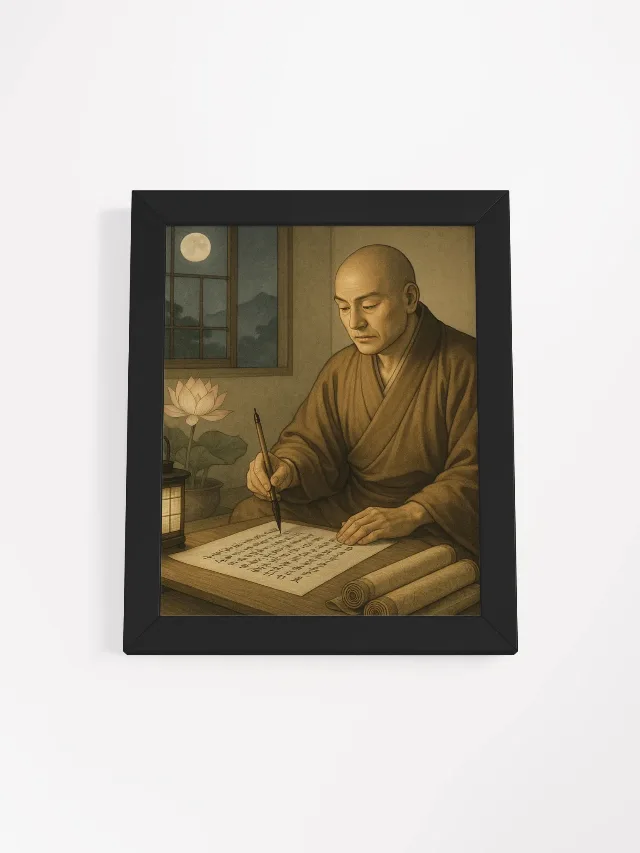
Letter From Sado was written from exile, in cold and scarcity, to followers who were frightened. It is not a polished essay on suffering. It is a working letter about how to keep going when the cost of practice is real, and it treats courage as something you practise rather than something you have.
A letter to frightened followers
Nichiren wrote the letter from Sado in 1272, to followers who were scattered and under pressure. Many of them were in Kamakura, where the authorities had made their allegiance costly.
The Sado exile followed his arrest and near-execution the previous year. He had been taken from Kamakura, sent to a remote island and left with little food, thin clothing and unfriendly guards. The conditions were meant to break him.
The letter does not hide this. It describes the cold, the shortage, the isolation. It also refuses to let those conditions be the final word.
Hardship is not abandonment
When life gets worse after you start practising, the first thought is often that you did something wrong. Maybe the practice is not working. Maybe you are not sincere enough. Maybe you have been forgotten.
Nichiren's letter takes that thought seriously and turns it around. The difficulty is not evidence that the Law has withdrawn. It is evidence that something is at stake.
That is not a comfortable message. It can be misused by people who want to justify suffering or keep others in harmful situations. The letter is not a reason to stay where you are being hurt.
What it offers is a way to read hardship without reading it as rejection. The people in Kamakura were afraid. Nichiren writes to steady them, not to explain away what they were going through.
The three obstacles and four devils
The letter draws on the framework of the three obstacles and four devils. The terms sound archaic, and the list can feel like a taxonomy from a very different world.
The plain meaning is simpler. When you commit to something serious, resistance appears. Some of it comes from inside you: doubt, fatigue, the urge to quit before you can fail. Some of it comes from the world: other people's disapproval, money problems, bad timing.
The letter's point is that resistance is normal. It is not a sign that you chose wrong. It is often a sign that you have touched something real.
That does not mean every obstacle is spiritual. Sometimes a cold is just a cold, and a difficult boss is just a difficult boss. The framework is a way of staying steady, not a way of over-interpreting everything.
Courage is a decision, not a feeling
Nichiren uses the image of a sword in the hands of a coward. The sword is not the problem. The tool is fine. The question is who is holding it.
The same is true of practice. The daimoku, the chanting of Nam Myoho Renge Kyo, is not weak because you are frightened. Your fear does not cancel the practice. You chant while afraid, and that is what courage looks like.
This is a useful correction to the idea that you must feel brave before you act. Most brave people do not feel brave. They feel frightened and act anyway.
The letter asks the followers in Kamakura to act anyway. To keep practising. To keep in contact. To not let fear make their decisions for them.
What exile gave him
There is a strange grace in the letter. Nichiren is writing from a place of deprivation, and he is also writing some of his most important work.
The exile removed him from the noise of Kamakura. It gave him time, however uncomfortable, to think and write. The letters and treatises from Sado include some of the clearest statements of his teaching.
That is not a reason to romanticise suffering. Exile was not a retreat. It was a punishment, and it hurt. But it is a reminder that a constrained life can still produce something.
If your own life has shrunk, through caring responsibilities or a job that drains you, the letter does not say that the shrinking is good. It says that the Law is not limited by your circumstances.
The letter itself is one of those things. It helps to remember what kind of text it is. Nichiren is not writing a systematic theology of suffering. He is writing to people he knows, in a situation he shares.
That is why the letter moves between his own conditions and their fear. He is not above them. He is in the same weather, on a colder part of the coast.
A sermon tells you what to think. A letter tells you how someone is staying alive. The second is more useful when you are the one in the storm.
You can read it as a model for your own messages to people who are struggling. Say what is true. Do not pretend it is easy. Then say what you are doing to keep going, and invite them to do the same.
Joy and difficulty can share a room
One of the most striking notes in the letter is its refusal to choose between sorrow and gladness. Nichiren can describe his conditions honestly and still insist that there is something worth rejoicing in.
The joy is not a denial of the cold. It is the joy of having something to practise for. Of being part of a community that has not disappeared. Of knowing that the work matters.
That is a mature faith. It does not need everything to be fine. It can hold a bad day and a good reason together.
How to apply it today
Name the one thing that has made you want to stop practising. Write it down. Do not argue with it. Just name it.
Then ask what you would tell a friend in the same situation. You would probably not tell them to quit. You would probably tell them to rest, to ask for help, to take one small step.
Do that for yourself. Keep the practice small enough to survive. One chant. One message to someone who understands. One honest sentence in a notebook.
And when the fear is loud, remember that the letter was written to people who were afraid. It was not written to heroes. It was written to ordinary practitioners who needed to hear that they were not alone.
Try this today. Write down the one thing that has made you want to stop. Then chant for five minutes and write one sentence about what you will do tomorrow. Keep it small and specific.
Reflection questions
- What have you been reading as abandonment that might be resistance?
- Where has fear been making your decisions for you?
- Who could you write to this week to remind them that they are not alone?
From Nichiren's writings. In Letter From Sado, Nichiren writes from exile to followers who were afraid, and tells them that opposition is not a sign they have been abandoned. He describes the obstacles that come with practice and asks them to meet those obstacles with a courage that grows through use.
Next step
What the persecutions teach us gives the full story of the exile and the years around it. Why obstacles appear when you start is the practical companion to this letter. And the Hard Times path gathers the pages for a season when everything feels heavy.
If you want to hear these writings read aloud, the videos are a gentle place to begin.