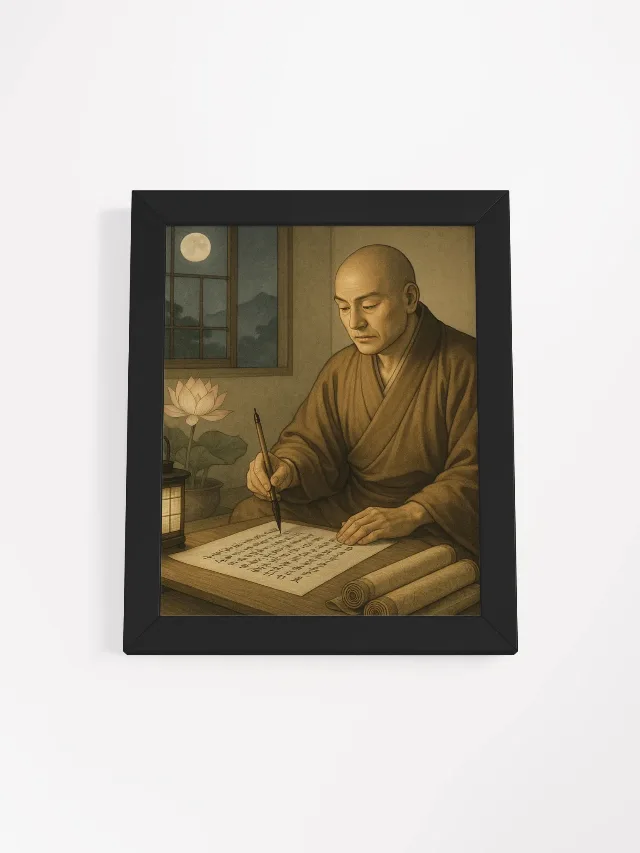
Letter to the Brothers was written to two young men whose father was trying to force them to abandon their practice. Nichiren's advice is not to win the argument. It is to stay steady, stay united, and let time do what argument cannot. The letter is about loyalty, patience and the long road back to a family table.
Two brothers, one household
The letter went to Munenaka and Munenaga, brothers from a samurai household in the Kamakura area. Their father was a man of standing, and he did not want his sons' religious commitment to damage the family's position.
His pressure was not abstract. The elder brother was told he would lose his inheritance if he did not give up his practice. In a society where inheritance meant housing, status and the ability to support a household, that was not a small threat.
Nichiren wrote to both brothers, but he writes with particular care about the elder, whose decision carried the heaviest practical cost. The letter is traditionally dated to 1275, when Nichiren was at Mount Minobu and the family was still divided.
The question underneath the letter is one many readers will recognise. How do you honour a parent and still live your own life?
Opposition can come from love
It is tempting to cast the father as the villain. Nichiren does not do that. He treats the father as a person with a real concern, even when that concern is expressed badly.
A parent who threatens disinheritance is often frightened. Frightened of what the neighbours will say. Frightened that a child is throwing away security. Frightened of losing influence in a family that is changing.
Seeing that fear does not excuse cruelty. It does make it easier to respond without hatred. Nichiren asks the brothers to hold their ground without turning their father into an enemy. That is harder than rebellion, and it is more useful.
Many practitioners describe a similar shift in family conflict. They stop trying to prove the other person wrong and start trying to stay connected. Sometimes the relationship improves. Sometimes it stays difficult but becomes more bearable.
The letter is addressed to two brothers, not one, and that matters. Nichiren asks them to stand together.
It would have been easy for the brothers to split. One could have complied and kept the inheritance. The other could have held firm and carried the cost alone. Family pressure often works by isolating one person until they give in.
Refusing to turn on each other is its own kind of faith. It says that the relationship is worth more than being right. It also gives each brother a witness, someone who knows what the practice costs and why it is still worth it.
If you have a sibling or a friend who shares your practice, this is the part of the letter to take seriously. Send the message. Ask how they are. Do not let a difficult season make you a stranger.
You cannot argue someone into faith
Nichiren does not give the brothers a script for winning a debate with their father. He does not tell them to out-argue him or to quote texts at him until he gives way.
Instead he points to conduct. Let your life show what the practice does. Be reliable. Keep your word. Do not give anyone a reason to say that your faith made you a worse son.
That approach is slower and less satisfying than a good argument. It is also the only one that tends to work. People rarely change their mind because they lost a debate. They change it because someone they love turns out to be steadier, kinder or more honest than expected.
There is a limit here. Patience is not the same as allowing yourself to be abused. If a family situation is violent or unsafe, the letter's call to steadiness does not mean you should stay in harm's way.
Obstacles are not a verdict
The brothers were probably asking the question many practitioners ask in a hard season. If this practice is good, why is my family falling apart?
Nichiren's answer is that difficulty is not evidence that you are on the wrong path. The three obstacles and four devils is his name for the resistance that appears when a person commits to something serious. Some of that resistance comes from inside. Some comes from the people around us.
This does not make every obstacle meaningful. Sometimes a difficult family is just a difficult family, and no lesson needs to be extracted from it. But the letter refuses the simple equation that ease means blessing and struggle means failure.
That refusal is a kindness. It lets you keep practising without pretending your life is easy.
What the letter says about inheritance
The father's threat was about money, land and status. Nichiren does not tell the brothers that these things do not matter. He knows they do.
What he does is widen the frame. There is an inheritance that cannot be taken away by a will or a quarrel. It is the wisdom and character a person builds through practice, and the relationships that survive pressure.
That is not a reason to be careless about money. It is a way to keep money in its place. If you lose an inheritance because of your integrity, you have lost something real. You have not lost everything.
How to apply it today
If your family opposes your practice, start by lowering the temperature. You do not need to explain yourself at every meal. One calm sentence is usually enough: "This matters to me, and I am not asking you to agree."
Then separate the argument from the relationship. Keep showing up for birthdays, help with the washing up, ask about their day. Let them see the practice in your conduct rather than in your defence of it.
Choose one person who shares your practice and stay in contact with them. Isolation is the pressure point. A weekly message can be enough to keep your footing.
And give it time. Family patterns move in years, not weeks. The letter is not a quick fix. It is a map for a long walk.
Try this today. Write down the sentence you most want to say to the person who opposes your practice. Do not send it. Chant for five minutes, then read it again and see whether it is still the sentence you want to send.
Reflection questions
- Where have you been treating a family member's fear as malice?
- Who shares your practice, and how could you stay closer to them this month?
- What would integrity look like in your family situation, even if it costs you something?
From Nichiren's writings. In Letter to the Brothers, Nichiren urges two brothers not to let their father's opposition divide them or wear down their commitment. He treats their steadiness and their loyalty to each other as the real inheritance, worth more than the property they were threatened with losing.
Next step
Relationships and family goes further into practising at home without turning the kitchen into a debate. The three obstacles and four devils explains the resistance this letter assumes. And when your family disapproves answers the practical question the brothers were living with.
If you would like a short daily anchor through a family storm, the newsletter sends one letter a week you can read with your morning tea.