A Buddhist home altar needs a flat surface, not a whole room. A shelf, a small table or the top of a bookcase will do. Add a clean cloth, a candle, a glass of water and, if you have one, your Gohonzon. Keep it safe, keep it simple, and let it grow slowly.
The first step is not buying things. It is finding a place.
Look for a surface that is stable, out of the way of foot traffic and easy to reach. A shelf at chest height is ideal. A side table beside a chair works. The top of a low bookcase can work if it is not crowded.
Check that the surface can take the weight and that nothing will tip. If you have children or pets, choose somewhere higher or behind a door.
You also want a little space around the altar. Leave room to sit in front of it, and room for a candle or a glass without crowding. If the surface is already full of post and chargers, clear it properly rather than pushing things to one side.
You do not need a dedicated room. Many people practise in a bedroom, a living room corner or a rented flat where space is tight. A small, consistent place is better than a grand one you never use.
What goes in the centre
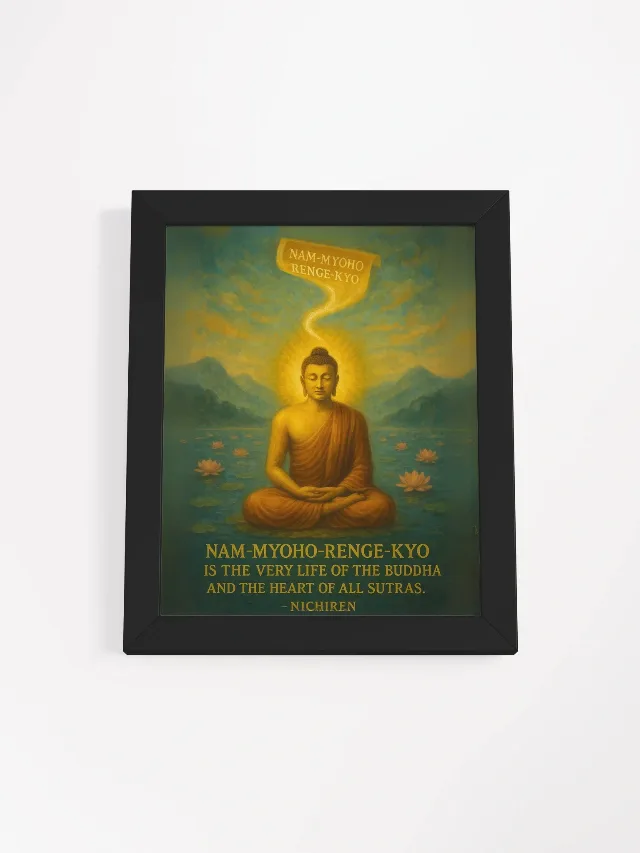
If you have received a Gohonzon, it goes in the centre. The Gohonzon is the scroll that many practitioners use as a focus for faith and chanting. It is usually kept in a butsudan, the altar cabinet or shrine where the scroll is housed.
If you do not have a Gohonzon, you can still set up a place to practise. Put a sutra book, a small image, a stone or a simple card with the chant in the centre. The object is a reminder, not a substitute for the practice.
Communities differ on how a Gohonzon is received and how it should be placed. If you are part of a local community, ask someone there for guidance. If you are practising alone, keep it simple and respectful, and do not worry about getting every detail right.
A word of caution: do not treat the centre object as a lucky charm. It is there to remind you of the practice, not to protect the house or bring good fortune on its own. The scroll, the book and the stone all point in the same direction: towards your own life and the chant.
The traditional offerings and what they mean
A traditional altar carries five offerings: water, flowers, incense, light and food. You do not need all five, and you do not need to understand each one before you begin.
For a first altar, water and light are enough. Put a small glass of water in front of the scroll or object, and a candle or LED light beside it. If you have a flower, a single stem in a small vase is plenty. Incense and food can wait until you have a routine.
The meaning of each offering is worth learning, but it is not a prerequisite. In short: water for clarity, flowers for impermanence, incense for a steady presence, light for wisdom, and food for gratitude. The guide to altar offerings explains each one in more detail.
What matters at the start is that the offerings are clean and given with attention. They are not payments, and they do not buy favour.
Keep it safe
Place the altar where it will not be knocked. A shelf above a busy walkway is risky; a corner table is better. If you have children or pets, put the candles and water out of reach.
An LED candle removes most of the risk. If you use a real flame, use a sturdy holder and never leave it burning when you leave the room or go to bed.
Incense needs a holder that catches ash and a little ventilation. If the smoke bothers anyone, skip it. Water should sit on a tray so a spill does not reach wood or electrics.
If you rent, avoid drilling into the wall. A freestanding shelf or a box altar can be moved when you leave.
Small spaces and shared homes
A full altar is not necessary. A "box altar" is a common solution: a small wooden box or a sturdy shoebox with a cloth inside. You open it for practice and close it afterwards.
A shelf with a curtain works too. So does a corner of a wardrobe, a windowsill or the top of a bedside table. The point is that the place is yours and that you can return to it.
If you share the flat, tell the people you live with what the space is for. A short sentence is usually enough: "This is where I sit quietly in the morning. I'll keep it tidy." Most people are more accepting than you might expect.
You do not have to explain your practice to anyone. But a little explanation can prevent a lot of awkwardness.
If the only space is a shared one, a lidded box is a good compromise. Set it up when you practise, put it away afterwards, and keep the contents together. The ritual of opening and closing the box can become part of the session.
Keeping it clean without making it a chore
A clean altar is easier to sit down at. A cluttered one becomes another thing to avoid.
Once a week, dust the surface and wipe it with a damp cloth. Change the water daily if you can, or every few days. Remove dead flowers before they droop. Throw away old incense ash.
Keep the cleaning simple. You do not need a special polish or a ritual for every task. A few minutes with a cloth is enough.
Do not turn the altar into a museum. It is a working place, not a display. A little disorder is fine. A stack of books beside it is fine. The aim is a place you can use, not a photograph.
If the space gets dusty, dust it. If the cloth gets marked, wash it. The altar is allowed to show signs of use.
Try this today. Clear one shelf or a small table. Wipe it down. Put a glass of water on it and sit in front of it for three minutes. That is your altar for now.
From Nichiren's writings. In The Real Aspect of the Gohonzon, Nichiren explains that the Gohonzon is not a picture of a distant Buddha. It expresses the Buddha's life in a form ordinary people can approach. The altar is simply the place where that approach happens. It does not need to be grand to be real.
Next step
For the meaning of the scroll itself, read The Gohonzon: What It Is and How to Relate to It.
Caring for Your Altar and Offerings goes further into the daily and weekly care of the space.
If you are still without a Gohonzon, Chanting Before You Have a Gohonzon shows you where to start.
The videos page shows what a simple practice space can look like.