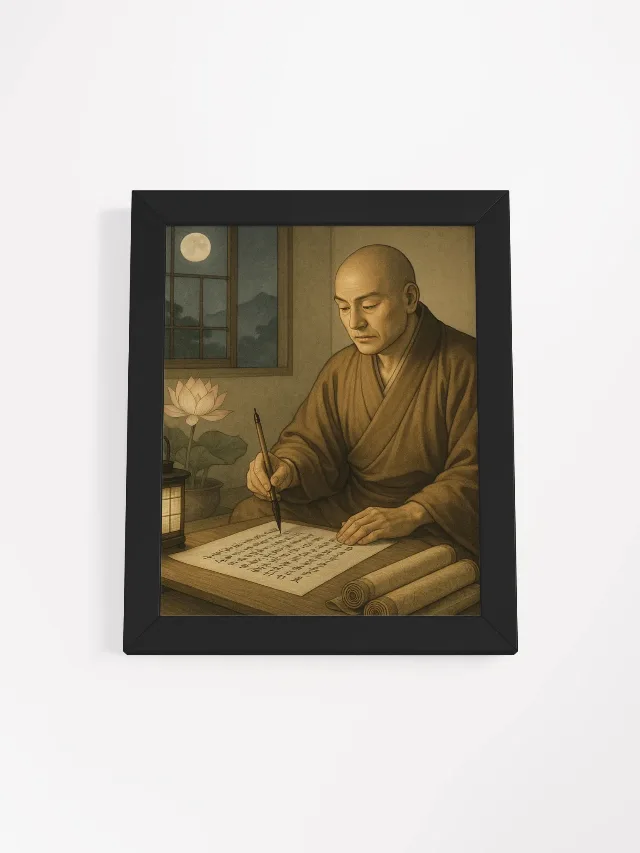
The Opening of the Eyes is Nichiren's defence of his life's work, written in exile on the island of Sado. It asks a question that still matters. How do you know whether a teaching is true, and what do you do when saying so costs you everything? His answer is measured, personal and unyielding.
Shijo Kingo, and a treatise written in exile
The treatise was addressed to Shijo Kingo, a samurai and physician in Kamakura, and one of Nichiren's longest-standing supporters. Kingo was not a scholar by trade. He was a practical man who had tied his family's fortunes to a teacher the authorities had condemned.
Nichiren completed it on Sado in 1272, during the exile that followed his arrest and near-execution at Tatsunokuchi the year before. His followers in Kamakura were under pressure, some had wavered, and rumours about him were circulating.
So the treatise does two jobs. It sets out the case for his teaching, and it steadies the people who had stayed with him. It is often read as a letter because of its warmth, but it is really an argument, written in two parts and sent to a friend.
The question behind the treatise
Nichiren had been asking, for years, why the country was suffering. Famine, disease and earthquakes had shaken Kamakura. The accepted answer was that the times were bad in a general way, or that people had been careless in their observances.
His answer was sharper. A society that relies on teachings which deny ordinary people's capacity to awaken will produce confusion and instability. The root problem is not bad weather. It is a mistaken ground of belief.
That claim made him powerful enemies. It also made him a difficult neighbour. The treatise is not a gentle invitation. It is a man explaining, at length, why he would not back down.
Three ways to test a teaching
The most useful part of the treatise for a modern reader is its method. Nichiren describes three kinds of proof.
The first is the document: what does the text itself say? The second is reason: does the argument hold together? The third is actual proof: what happens in a life when the teaching is put into practice?
This is a surprisingly practical set of tests. It does not ask you to accept a claim because a teacher is impressive. It asks whether the claim is consistent with its sources, whether it makes sense, and whether it produces something in the world.
You can use the same method on your own beliefs. What is the source of this idea? Does it survive scrutiny? Has it made me more honest, more patient, more able to face difficulty? The third question is the one that takes time.
Why persecution did not change his mind
The treatise returns again and again to the fact that Nichiren had been attacked, exiled and nearly killed. He does not present this as bad luck. He reads it as evidence about what happens when a person speaks plainly in a hostile time.
This is a dangerous idea if it is used badly. Anyone can claim that opposition proves they are right. Nichiren does not offer that shortcut. He argues from the content of the teaching, not merely from his suffering.
Still, the personal sections matter. They show a man who had counted the cost and decided that the cost was not the deciding factor. That is different from stubbornness. Stubbornness refuses to listen. Conviction listens, then stands.
Readers do not have to agree with every argument in the treatise. It belongs to a fierce controversy in thirteenth-century Japan. What travels is the honesty of the method and the refusal to let fear set the terms.
Fame, profit and the price of honesty
One of the recurring themes is the temptation to soften a message in order to be liked. Nichiren describes teachers who trim their words to keep invitations, donations and reputations coming.
He is not against a quiet life. He is against a life in which truth is traded for comfort. The treatise asks what you are willing to lose in order to say what you actually think.
Most of us will never face exile. We do face smaller versions of the same test. The conversation at work where silence is easier. The family dinner where you let a cruel joke pass. The moment when being honest would cost you a friendship.
The letter does not demand that you pick a fight every day. It asks you to notice when your silence has stopped being tact and started being self-protection.
The temptation is not confined to temples. It shows up in any life where being liked has become more important than being honest. The cost is usually small at first, and then one day you cannot remember what you actually think. The treatise asks you to keep that memory alive.
What the treatise asks of a reader today
It asks you to take ideas seriously. Not to collect them, not to use them as decoration, but to test them against your life.
It asks you to be suspicious of comfort that comes at the price of honesty. And it asks you to be patient with people who are not ready to hear what you have understood. Nichiren spent years arguing. He did not expect instant agreement.
It also offers a warning. A strong conviction can become a way of looking down on others. The moment your certainty makes you contemptuous, you have stopped practising the thing the treatise is defending.
Read it, then, with respect and with your own judgement switched on. That is probably what its author would have wanted.
How to apply it today
Take one belief you hold about your practice and test it with the three proofs. Write what the source says. Write what reason suggests. Then write what you have actually seen in your life over the past year. Be honest about the gaps.
Next, look at one place where you have been softening your own truth to keep the peace. Ask whether the softening is kindness or fear. Sometimes it is kindness. Sometimes it is a small surrender you have stopped noticing.
Finally, do not confuse being disliked with being right. The treatise can tempt readers into thinking that opposition is a badge of honour. It is not. The badge is integrity, and it is possible to be both honest and wrong.
Try this today. Take a notebook and rule three columns: source, reason, experience. Put one conviction you hold about chanting at the top, then fill each column for five minutes. Do not correct anything. Just see what is there.
Reflection questions
- Which of the three proofs do you rely on most, and which one have you been avoiding?
- Where has your silence stopped being tact and started being self-protection?
- How can you hold a strong conviction without becoming contemptuous of people who disagree?
From Nichiren's writings. In The Opening of the Eyes, Nichiren sets out why he would not soften his message under threat, and describes three kinds of proof by which a teaching can be tested: what the written source says, what reason supports, and what is actually borne out in a life.
Next step
What the persecutions teach us gives the historical background to the exile this treatise was written in. The three obstacles and four devils explains the language of resistance that runs through it. And was Nichiren a Buddha or a bodhisattva takes up the question the treatise raises about its author.
If you learn best by listening, the videos include short introductions to the major writings.