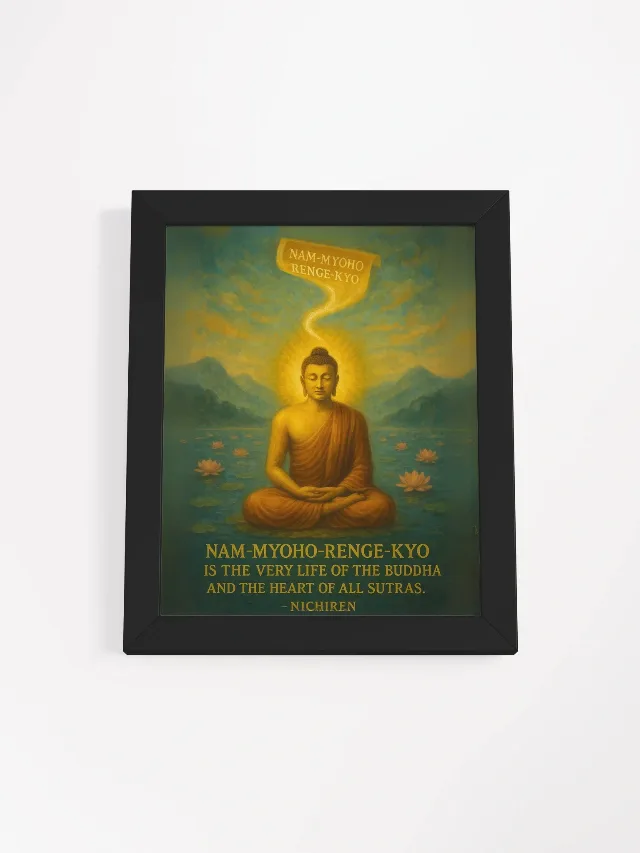
The Gohonzon is a scroll inscribed with Nam Myoho Renge Kyo, surrounded by figures from the Lotus Sutra. It is a focus for chanting, not a god to be appeased. Practitioners treat it as a mirror of the buddha nature in their own lives. You do not need one to begin, and how people receive one varies between communities.
Go is an honorific, a polite prefix. Honzon means an object of fundamental respect: the thing you place at the centre of your practice. So the word names the scroll you face when you chant, nothing more complicated than that. It is also called a mandala, which in this context means a map of enlightenment rather than a map of a place. If you want the bare definition, the glossary entry is enough to start with.
The scroll comes from Nichiren, the thirteenth-century Japanese monk whose teaching this site follows. He lived from 1222 to 1282 and spent his adult life arguing that the Lotus Sutra was the highest of the Buddha's teachings and that its title, Nam Myoho Renge Kyo, was the practice for ordinary people. In the last years of his life he inscribed scrolls for individual followers. The earliest full mandala Gohonzon that survives is dated 1273, when he was in exile on Sado Island. That same year he wrote The Object of Devotion for Observing the Mind, which sets out the principle behind the scroll.
He did not invent a new god. He made a visual summary of a scene from the Lotus Sutra and put the title at the centre. The scroll is a teaching aid as much as a sacred object. It is meant to be looked at, returned to, and gradually understood.
The date matters for another reason. It places the first full Gohonzon in the middle of an exile, when Nichiren had lost his freedom and many of his followers were under pressure to abandon the practice. The scroll was not made in a comfortable study. It was made in a place of hardship, for people who were also struggling. That context is worth remembering when you look at one.
Communities differ in which scrolls they use, how they are reproduced, and how they are passed on. Those differences matter to the people involved, but they are not a measure of sincerity. The life of Nichiren explains more about the man and the world he wrote for.
Most Gohonzons share a basic design. Nam Myoho Renge Kyo runs down the centre in large characters. Near the top are Shakyamuni, the historical Buddha, and Many Treasures Buddha, the figure who appears in the eleventh chapter of the Lotus Sutra to confirm that the teaching is true. Around them are figures from the assembly: bodhisattvas, voice-hearers, heavenly beings, guardian deities, the sun and moon. The exact arrangement differs from scroll to scroll.
The title at the centre
The central inscription is the title of the Lotus Sutra, preceded by the word nam, which expresses devotion or a bow. In this practice the title is not a label for a book. It is the whole teaching in a form you can say out loud. Nichiren taught that in the Latter Day of the Law, when people are too distracted and too far from the Buddha's time to follow the old paths, the title itself is the practice. The meaning of the chant is worth reading alongside the scroll.
The two buddhas
Shakyamuni is the historical teacher, the man who lived in India and taught the sutras. Many Treasures Buddha is the figure who appears in the Treasure Tower chapter to say that the Lotus Sutra is true. Their presence together says something simple: the teaching is attested by the past and spoken in the present. The Treasure Tower and the Ceremony in the Air explains that scene in more detail.
The rest of the scroll is a crowd. There are bodhisattvas, voice-hearers who heard the Buddha directly, heavenly kings, the sun and moon, and guardian figures. The ten worlds are represented too, the full range of human experience from hell to buddhahood, so that nothing in your life is left outside the assembly. At the centre of all that noise is the title. The Ten Worlds is a useful next read if the figures make you curious.
The whole image represents the Ceremony in the Air, the vast gathering described in the Lotus Sutra. The setting is Eagle Peak, but the assembly is not a memory. It is shown as happening now, with you in it. That is the point of facing it. The glossary entry for Eagle Peak gives the basic reference.
Many scrolls also carry a dedication at the bottom, naming the person they were inscribed for and the date. That detail is easy to miss. It is a reminder that the Gohonzon began as a personal gift, not an anonymous poster. If you have a copy, look at the small characters before you look at the large ones.
You do not need to identify every figure. Most practitioners never learn all the names. The central characters are enough to begin with: the title you are chanting, held in the middle of a gathered world.
Some people find the imagery busy at first. Others find it reassuring, like walking into a room where a large family is already seated. Either response is fine. The scroll is not a test of visual literacy.
Is the Gohonzon an idol or a lucky charm?
No. It is not a deity, and it is not a talisman. It does not hear requests, choose winners, or bring luck. It is a focus for attention and a mirror for the practice.
This distinction matters, because it changes what you do with it. You are not trying to persuade an object to like you. You are not performing a correct ritual to earn a reward. You are sitting down, facing a representation of the law of life, and chanting to wake up to that law in your own body and mind.
Nichiren's writing returns to this point. The object of devotion is not something outside you that you beg for help. It is the buddha nature of your own life, made visible so that you can trust it. The scroll is a support, not a substitute.
Respect is still part of the practice. You keep the scroll clean, place it at a sensible height, and offer water or a flower. Not because the object is hungry, but because attention and gratitude are habits worth building. A bow is not a transaction. It is a way of arriving.
Some people grow up fearing that sacred objects are easy to offend. If that is you, you may need time to relax into this. Nothing bad will happen if you forget to change the water. The practice is not looking for a reason to punish you.
Do you need one to practise?
No. The chant is the practice. You can begin today with a wall, a window, a candle, or a blank piece of paper with the title written on it. Many people chant for months before they have a scroll, and some never have one.
Communities differ on this. Some teach that a Gohonzon should be received in a particular way, through a local community and a ceremony. Others encourage people to start where they are and let the question of a scroll answer itself later. Neither approach is a reason to delay the first five minutes.
If you are waiting until you have a proper altar, a quiet room, and a clear understanding of every symbol, you may wait a long time. Practice is allowed to be unfinished. The first year of chanting is usually messy: a corner of a bedroom, a cushion that is too thin, a mind that will not settle. That is not a failed version of the practice. It is the practice. Chanting before you have a Gohonzon is a good companion if this is where you are.
There is also no rule that says you must want one. Some practitioners are content with the chant and a quiet corner. That is a complete practice, not a half one.
How do people receive one?
There is no single answer.
Some practitioners receive a scroll through a local community, after a conversation or a ceremony. Some receive a copy from a teacher or a friend. Some use a printed card, a small reproduced inscription, or a photograph of a scroll. Some practise for years without one and feel no lack.
What is consistent is that the scroll is meant to support practice, not to mark status. A larger altar is not a sign of deeper faith. A borrowed card can hold the same attention as an elaborate cabinet.
If you are looking into receiving one, ask the community you are drawn to how they do it, what is expected of you, and what the scroll means in their practice. Ask more than one person if you can. A good answer will point you back to your own life, not to the object.
You may also meet people who treat the scroll as a reward for seniority, or as a sign that they belong and you do not. Try not to take that on. The practice is not a queue, and the scroll is not a badge. If a community makes you feel small, you are allowed to keep looking.
We do not rank the ways communities handle the scroll. What matters is that you can keep practising and keep reading what Nichiren himself wrote.
Setting it up and caring for it
A butsudan is a home altar, usually a small cabinet with doors. You do not need a cabinet. A shelf at chest height, a wooden box, or a clear corner of a desk can work. What matters is that the place is stable, clean, and used only for practice if possible. The glossary entry for butsudan covers the basic furniture, and Setting Up a Simple Home Altar walks through the practical choices.
Place the scroll so that it is at or slightly above eye level when you are seated. Avoid direct sunlight, damp, steam, and the floor. If you share your home, a cabinet that closes is practical and respectful. Chanting in a shared home has suggestions for small spaces.
Keep the area tidy. Offer fresh water daily if that fits your routine, and replace flowers before they wilt. A small light, a candle, or a bowl of fruit is enough. You do not need to buy anything special. Caring for your altar and offerings explains the usual options without turning them into rules.
Once a week, dust the cabinet and the frame. Change the water. Throw out the old flowers. This is not housework for its own sake. It is a small signal to yourself that the time you spend here matters.
Open the doors in the morning and close them at night if that is the custom in your community. If you are not sure, do what helps you treat the space as set apart. The ritual is there to slow you down, not to test you.
A note on fear: some people worry that they will offend the scroll by placing it badly, forgetting to change the water, or chanting in the wrong direction. The practice is not that fragile. Sincerity matters more than perfect arrangement. If you knock something over, pick it up and carry on.
How to relate to it when you chant
Face the scroll, sit comfortably, and greet it in whatever way feels natural: a bow, a moment of silence, a hand on your heart. Then chant.
You do not have to stare at it. Some people rest their eyes on the central characters. Some close their eyes after a minute. Some look at the figures and let the mind settle. All of these are fine. There is no single correct eyeline, and no penalty for blinking.
Before you begin, you might name what you are bringing: a decision, a worry, a person you are thinking of. After you finish, sit still for a moment before you stand up. That pause is part of the practice. It gives the words somewhere to land.
The scroll is not a scoreboard. Your mind will wander. You will have days when the words feel empty and days when the room feels warm. Neither proves anything about you. What to do when you feel nothing may help on the flat days.
Faith in the Gohonzon, in this practice, means trust in the life you are facing. The scroll is there to remind you of that trust, not to replace it. What the Gohonzon Represents explores that idea in more depth.
If you want a simple rhythm, try this: open the doors, offer water, bow, chant for five or ten minutes, sit quietly for one minute, bow, close the doors. The same shape every day will do more for you than a perfect session once a month. Building a daily practice can help you keep it going when the first enthusiasm fades.
Doubt, travel and shared homes
Doubt is normal. You may look at the scroll and think, "This is ink on paper." That thought is not disrespect. It is a question, and questions are allowed. Keep chanting and keep asking. When you doubt your practice is written for exactly that moment.
When you travel, you do not have to carry the scroll. Many practitioners chant without it, or use a small card or a photograph as a reminder. The practice travels with you because the chant travels with you. Nothing is lost if the scroll stays at home.
In a shared home, a closed cabinet, a shelf in your room, or a box that you open only for practice is enough. You do not need to explain it to everyone. A simple sentence, "This is where I sit quietly for a few minutes," is often all that is needed.
If children are curious, let them look. If a visitor asks, answer as much as you want to. The scroll is not a secret, and it is not a performance. You are allowed to keep your practice ordinary.
Try this today. Go to the place where you usually chant, or choose one. Clear a space the width of a sheet of paper. Put down one small thing: a glass of water, a flower, a stone. Sit for five minutes and chant. Do not fix anything else.
From Nichiren's writings. In The Real Aspect of the Gohonzon, Nichiren explains to a follower that the scroll is not a power outside her. It is the reality of her own life, shown to her so that she can believe in it. The practice is to trust what the mirror shows her, especially on the days she cannot feel it.
Next step
If you want to understand the scroll more deeply, read What the Gohonzon Represents. It walks through the symbolism slowly, without assuming you know the Lotus Sutra.
If you are practising without one, Chanting Before You Have a Gohonzon will help you set up a simple place and stop waiting for perfect conditions.
For the practical side of a home altar, Setting Up a Simple Home Altar covers space, height, offerings and what to do when the room is shared.
When you are ready, try the five-minute chant timer. It counts the minutes so you can forget about the clock and stay with the words.