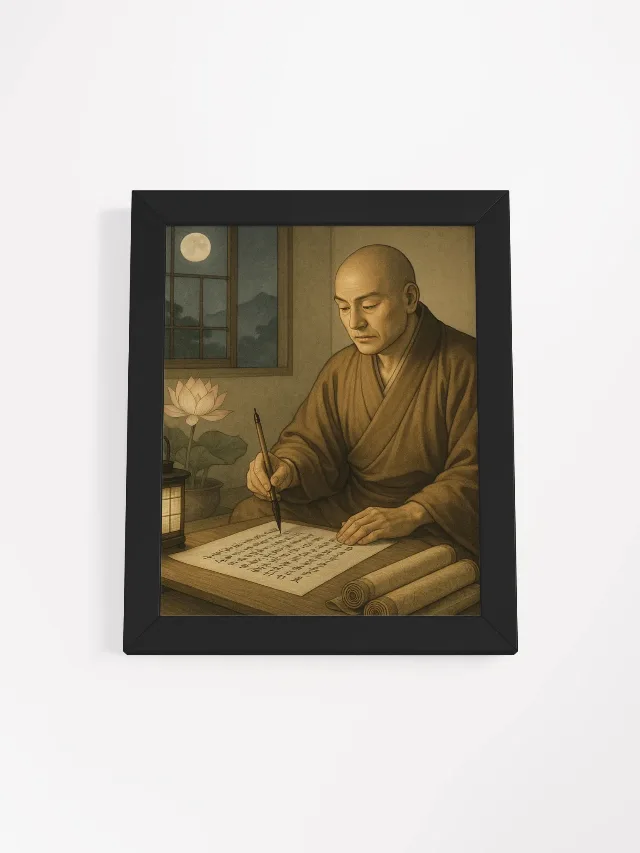
The Three Kinds of Treasure separates three things people call wealth: money in the storehouse, health in the body, and wisdom in the heart. Nichiren's argument is that the third is the one that secures the other two, and that a person's conduct is the clearest sign of what they actually value.
A letter about work and worth
The letter was sent to Shijo Kingo, a samurai physician who received many of Nichiren's most personal letters. Kingo was going through a strained period at work, trying to serve his lord well while others spoke against him.
The letter is traditionally dated to 1277. Nichiren was at Mount Minobu, far from the politics of Kamakura, but close enough to Kingo to know what the pressure was doing to him.
It is worth noticing who Nichiren is writing to. Kingo was not a wealthy man by the standards of his world, and he was not poor. He was somewhere in the middle, responsible for a family, worried about status and money. That is the audience for a letter about treasure.
Three kinds of wealth
The first treasure is the treasure of the storehouse. Money, goods, property, the things that keep a household running. Nichiren does not despise it. A person with no storehouse is vulnerable, and pretending otherwise is not spiritual wisdom.
The second is the treasure of the body. Health, strength, the ability to work and move and care for others. Also real, also fragile. Anyone who has been ill for a long time knows how much of life is built on the body's cooperation.
The third is the treasure of the heart. Wisdom, integrity, the capacity to see clearly and act well. This is the one Nichiren ranks highest, because it shapes what you do with the other two.
The ranking is not a rejection of the first two. It is a question of order. Get the heart wrong and the other treasures become a way of hurting yourself and others.
Money is real, and it is not the measure
There is a version of spiritual teaching that treats money as dirty. It can sound elevated, and it usually comes from people who have enough of it.
Nichiren does not take that line. He knows his follower needs to eat. He knows that losing a position can mean losing a home. The letter does not tell Kingo to stop caring about material security.
What it does is refuse to let money become the measure of a person. A rich man who lies is not a success. A poor woman who keeps her word is not a failure. The market does not know the difference. The heart does.
That distinction is useful when you are under financial pressure. It does not pay the bill. It does keep the bill from becoming the whole story.
Health is a treasure, not a virtue
The second treasure is easy to moralise. People who are well can start to believe that illness is a sign of something they got right. People who are ill can start to believe it is a punishment.
The letter treats health as a treasure. Something valuable, something to care for, something that can be lost through no fault of your own.
That means taking care of your body is part of practice, not a distraction from it. Sleep, food, movement, medical care. A body that is running on empty has less room for attention.
It also means you do not have to earn your illness. If you are unwell, the practice is still yours. You do not become a worse practitioner because your body is struggling.
Rest is not laziness. Asking for help is not weakness. The body is not a machine you can push indefinitely and then blame for breaking. A practitioner who ignores their health in order to practise more is not being devout. They are borrowing against tomorrow.
The heart is the treasure you carry
Wealth in a storehouse can be taken by a thief, a fire or a bad decision. Health can be taken by an accident. The treasure of the heart is harder to steal.
That is not because it is invulnerable. It can be neglected, corrupted, worn down by years of small compromises. But it is not held in a vault. It travels with you.
Nichiren's claim is that this treasure is built through practice. Chanting, study, honest conduct, the company you keep. It grows slowly, like a muscle, and it shows up when you need it.
It also shows up in what you notice. A person whose heart is trained sees the chance to be kind before the chance to be right. They hear the fear underneath an angry sentence. That kind of wealth does not announce itself. It just makes the room easier to be in.
Sincerity at work is practice
Much of the letter is about how Kingo does his job. Not the job itself. The way he does it.
Nichiren praises sincerity. Not brilliance, not ambition, not the ability to impress. The plain willingness to serve well when no one is watching.
That is a standard you can meet on a bad day. You may not be able to change your circumstances, but you can decide how you treat the person in front of you. You can keep your word. You can do the unglamorous part properly.
This is where the three treasures meet. Your work is how you use your money, your body and your heart at the same time.
It is also where the letter becomes practical. You do not need a better job to start. You need the job you have, and one honest hour in it.
How to apply it today
List three things you own that you would call treasures. Then list three qualities you want people to remember you for. Notice the gap between the lists.
Look at your week and find one place where you traded the third treasure for the first. A lie to protect a deal. A silence to protect a reputation. You do not have to be dramatic about it. Just notice.
Then choose one small act of sincerity. Return the thing you borrowed. Admit the mistake before it is discovered. Give the credit away.
And take care of the middle treasure. Go to bed earlier. Drink water. Book the appointment you have been avoiding. The body is not an obstacle to practice. It is where practice happens.
Try this today. Write down one quality you want to be known for. Then choose one action today that a person with that quality would take, and do it before the day ends.
Reflection questions
- Which of the three treasures have you been treating as the only one that matters?
- Where have you traded integrity for security, and what did it cost you?
- What would it look like to serve well in your current work, even if no one notices?
From Nichiren's writings. In The Three Kinds of Treasure, Nichiren tells Shijo Kingo that wealth comes in three forms: material goods, bodily health, and the treasure of the heart. He places the heart first, because wisdom and integrity shape how the other two are used.
A gentle note. Chanting can sit alongside professional care, but it is not a substitute for it. If you are in crisis or need someone to talk to, please reach out to a local helpline through findahelpline.com.
Next step
Money, work and practice goes further into the relationship between income and faith. Is it okay to chant for money, a job or a partner answers a question many people are ashamed to ask. And chanting for your career turns the letter's values towards ambition.
The newsletter sends one short reflection each week, free.