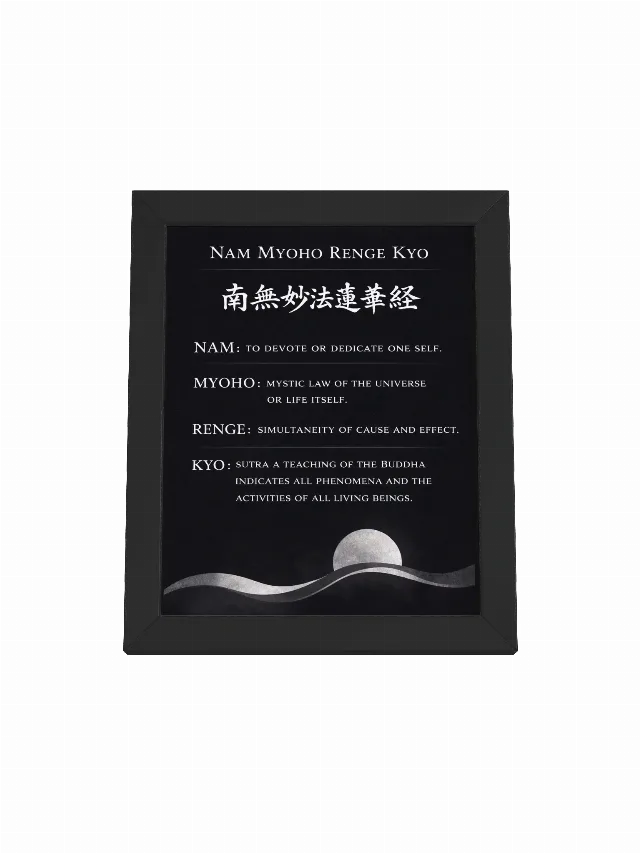
The Three Great Secret Laws are three elements Nichiren identified as central to practice in the latter age. They are the object of devotion, the place of practice, and the title of the Lotus Sutra, Nam Myoho Renge Kyo. They are called secret not because they are hidden, but because they are easy to overlook.
The three, one by one
The object of devotion is the honzon, the thing towards which practice is directed. In Nichiren's teaching this is the gohonzon, a scroll or tablet inscribed with the title and the names of beings in the assembly. It is not a god to be appeased. It is a mirror of the enlightened life.
The place of practice is the kaidan, traditionally translated as the ordination platform or sanctuary. It is the place where the teaching is upheld and practised. Communities differ widely on how literally to take this, and some treat it as a future ideal rather than a building.
The title is the daimoku, the chanting of Nam Myoho Renge Kyo, the title of the Lotus Sutra. Chanting it is the practice that makes the other two live.
Why "secret"?
The word does not mean esoteric knowledge reserved for insiders. It points to something that was not plainly set out before Nichiren's time, and to something that is easily missed even when it is right in front of you.
A mirror is a good comparison. Nothing is hidden inside it, yet people walk past mirrors every day without looking. The "secret" is the obvious thing you have not yet taken seriously.
Nichiren's writings also use the word to mark these three as the heart of the teaching, not as an extra list of rules. They are meant to be practised, not merely admired.
How communities differ
This is one of the areas where practice and emphasis vary most. Some communities focus on the physical gohonzon and a specific place of practice. Others stress the inner meaning of the three and treat the sanctuary as a symbol of a society that upholds the Law.
Some teach that all three are present whenever a person chants in front of the gohonzon. Others separate them more carefully and study each in detail.
What stays consistent in Nichiren's writings is the centrality of the daimoku and the conviction that ordinary people can practise this in their own homes.
What this means for a beginner
You do not need to master the doctrine before you begin. If you chant Nam Myoho Renge Kyo in front of a gohonzon, or before a plain wall while you wait for one, you are already inside the three.
Study can come later. Practice comes first, and understanding deepens as the practice continues.
Try this today. Sit in front of your altar or a plain wall, chant for five minutes, and afterwards name the three things the teaching points to: the object, the place, the phrase.
From Nichiren's writings. In The Object of Devotion for Observing the Mind, Nichiren sets out the object of devotion and the title of the Lotus Sutra as the practice for ordinary people. The treatise argues that the whole of life is contained in the moment of faith.
Next step
The Three Great Secret Laws examines each one in detail. The Gohonzon: What It Is and How to Relate to It covers the object of devotion. What Is the Latter Day of the Law? explains the age these laws are meant for.
To practise rather than only read, open the chant timer.