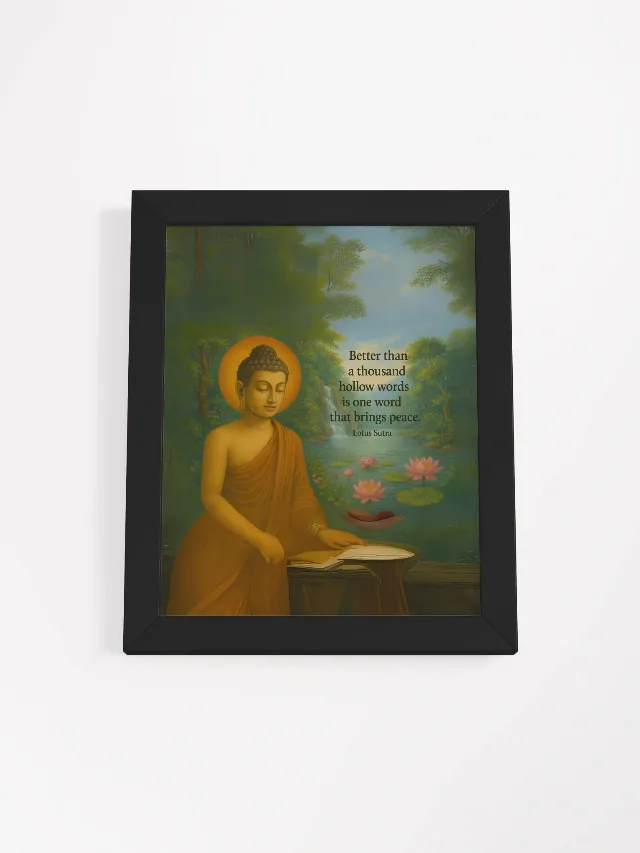
Gongyo usually recites parts of two chapters of the Lotus Sutra, a Buddhist scripture: the Expedient Means chapter, the second, and the Life Span chapter, the sixteenth. From the second it takes a passage on the ten factors of life. From the sixteenth, a verse section called the jigage.
The Expedient Means chapter
This is the second chapter of the sutra, and it does a lot of work. Its title refers to skilful means: ways of teaching that meet people where they are, rather than handing everyone the same formula.
The chapter makes a wide claim. It says that the Buddha appeared in the world to open the door of Buddha wisdom to all beings. The capacity to wake up is not limited to a select few.
The passage recited in gongyo is often called the ten factors. It lists ten aspects of any moment of life, from its appearance and nature through to its effects and its overall consistency. The list is not meant as a definition. It is a way of saying that nothing is as simple as it looks.
The Life Span chapter
The sixteenth chapter is the sutra's turning point. The Buddha reveals that his life is not limited to the years he spent in the world. He has been present all along, teaching, and his life is immeasurable.
The verse section, the jigage, restates this in poetry. It is the part many people recognise by its rhythm, even before they understand the words.
The teaching matters for ordinary life. It says that the deepest thing in a person is not measured by age, circumstance or failure. Whatever your life looks like from the outside, there is more to it than that.
Why these two together
One chapter opens the door: everyone can wake up. The other gives the ground: the life in which that happens is larger than it appears.
Together they form a short summary of the sutra's core. That is likely why they were chosen for daily recitation. You do not need to read all twenty-eight chapters to touch the central argument.
Nichiren treated these chapters as essential. The Life Span chapter in particular shaped his understanding of what the Buddha is and what a human life contains.
How the recitation varies
Communities differ in how much they recite, which language they use, and how they chant. Some use a Japanese text, some a translation, and some a mixture of both. The melody and pace vary too.
Some services add other sections, such as a dedication or additional verses. A few use a much shorter form for daily practice and a longer one for gatherings.
None of this changes the purpose. The words are there to be said and heard, not performed perfectly.
From Nichiren's writings. In The Opening of the Eyes, Nichiren explains why he continues to teach despite persecution, and sets out what he understands the Buddha's life to be. The argument is not abstract. It is a defence of a practice he had already chosen to live by.
Try this today. Read the short overview on the gongyo page, then chant for five minutes. The recitation can wait until it feels natural; the chanting does not need to.
Next step
The Lotus Sutra: A Guide to Its Teachings gives the whole text its context.
The Expedient Means Chapter and The Life Span Chapter take each passage in turn.
If you are learning the service, Gongyo: What It Is and How to Do It shows where these recitations fit.
If you want to hear the shape before you read further, the Videos section has recordings you can follow.