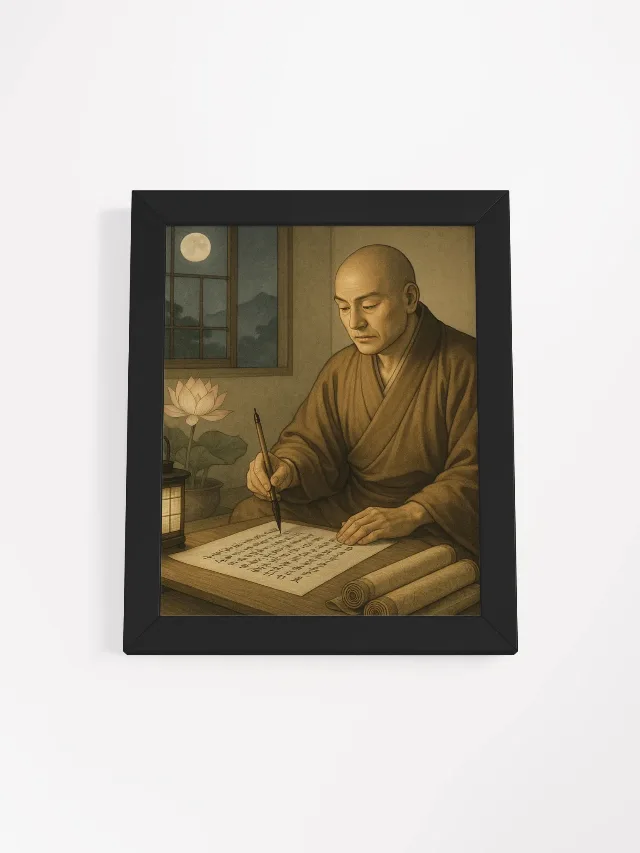
On Establishing the Correct Teaching for the Peace of the Land is a treatise about cause. Faced with famine, disease and earthquakes, Nichiren argued that a society's troubles grow from the beliefs it lives by, and that peace begins with honesty about those causes. It is his first major work, and still his most public one.
An appeal to the powers in Kamakura
Nichiren submitted the treatise in 1260 to the retired regent in Kamakura, the effective centre of political power. This was not a private letter to a friend. It was an appeal to the people who could change policy.
The country had been through a run of disasters. Harvests had failed, disease had spread, and the ground itself had shaken. People were frightened, and the authorities were looking for explanations.
Nichiren was about thirty-eight. He had spent years studying the sutras and had become convinced that the root of the troubles was a mistaken understanding of what a human being is and what a teaching is for. The treatise is his attempt to say so in a form that a ruler might read.
The treatise is written as a dialogue between a guest and a host. The guest raises the obvious question: why is the land suffering? The host answers, the guest pushes back, and the argument unfolds.
That form is worth noticing. Nichiren does not begin with a verdict. He begins with a question a worried person might actually ask. The reader is invited into the conversation rather than scolded from the first page.
It also lets him voice objections. The guest is not a straw man. He asks reasonable questions about whether the times are simply bad, whether the old ways might still be enough, and whether a loud reformer is what the country needs.
Good writing often works like this. You take the reader's doubt seriously, and then you answer it.
Suffering has causes
The core argument is that disasters are not random. Some causes are natural. Some are human. And the human causes include the ideas a society trusts.
Nichiren's claim is specific. If a society assumes that ordinary people cannot awaken, it will organise itself around dependency and passivity. A country can perform every ritual and still be at peace with none of its people.
You do not have to accept his thirteenth-century diagnosis to see the shape of the method. When something goes badly wrong, ask what produced it. Do not stop at "these are bad times". Look for the assumptions underneath.
The land and the person are not separate
Behind the treatise is the principle later called the oneness of life and its environment. Your inner life and your surroundings are not two unrelated things. They shape each other.
A person who believes their life is fundamentally worthless will build a world that confirms it. A society that treats people as disposable will produce the loneliness and violence it claims to deplore. The outside and the inside move together.
This is not a way of blaming victims. It is a way of saying that change has to happen at both levels. You cannot fix a country by rearranging its institutions if the people inside them still believe that most humans are beyond help.
What the title actually means
The title is easy to skim past. "Correct teaching" sounds like a claim to own the truth, and "peace of the land" sounds like a political slogan.
In Nichiren's usage, the correct teaching is the one that tells the truth about human beings: that every person, without exception, carries the capacity to awaken. Peace of the land is what follows when a society organises itself around that truth rather than against it.
The order matters. Peace is not produced by shouting the word. It is produced by correcting the ground. A country can have quiet streets and still be at war with its own people. A household can have no arguments and still be held together by fear.
That is why the treatise spends so long on belief. Get the foundation wrong and the building will keep cracking, however often you repaint it.
Blame is the lazy answer
When a society is frightened, it looks for someone to blame. A minority. A foreign power. A group with different customs. The gesture feels like action, and it costs nothing.
Nichiren's treatise resists that gesture, at least in its method. He locates the problem in a shared way of thinking, not in a hated group. His tone is fierce, and some of his language belongs to a religious controversy we no longer live inside. But the analytical move is worth keeping.
Ask who benefits when hard times are blamed on the weakest people in the room. Ask what the blame is designed to protect. Those questions are as useful now as they were then.
Reading it without the feud
This is the hardest part of the treatise for a modern reader. Nichiren argues against the dominant teachings of his time with real vehemence. He was living in a world where ideas about salvation had political consequences, and he wrote like a man in a fight.
Readers today come from many backgrounds. You can value the treatise's courage and its diagnosis without adopting its polemic. You can hold your own faith with conviction and still treat people of other faiths with respect.
What is consistent in Nichiren's writings is the insistence that ordinary people can awaken, and that a society should be organised around that possibility. That is the thread worth pulling.
How to apply it today
Start with your own environment. What are the assumptions in your workplace, your family or your neighbourhood about who matters and who can change? You do not have to fix them. You can notice them.
Then look at how you explain trouble. When something goes wrong at work or at home, do you reach for a culprit or for a cause? The first is faster. The second is more useful.
Choose one small action that improves the shared space. Pick up the litter. Learn a neighbour's name. Speak up once in a meeting when someone is being talked over. Peace of the land is built at that scale as well as at the scale of policy.
And keep your own practice honest. A calm mind is not a substitute for a fair society, and a fair society is not a substitute for a calm mind.
Try this today. Think of one thing in your street, workplace or family that troubles you. Write three possible causes, including one that involves you. Chant for five minutes, then choose one small action you could take this week.
Reflection questions
- What shared assumption in your community makes life harder for people who are already struggling?
- When you explain a problem, do you look for a culprit or for a cause?
- What would peace in your own small part of the land actually require of you?
From Nichiren's writings. In On Establishing the Correct Teaching for the Peace of the Land, Nichiren has a guest and a host reason together about why a country suffers. The conclusion is that a land cannot be at peace while its guiding teaching demeans ordinary people, and that correcting the ground of belief is the first work of peace.
Next step
Why Nichiren wrote this treatise tells the story behind the text and the reaction it received. The oneness of life and its environment explains the principle that holds the argument together. And why Nichiren criticised other schools helps with the parts of the treatise that are hardest to read today.
The newsletter is a good place to keep thinking about practice and the world you live in.