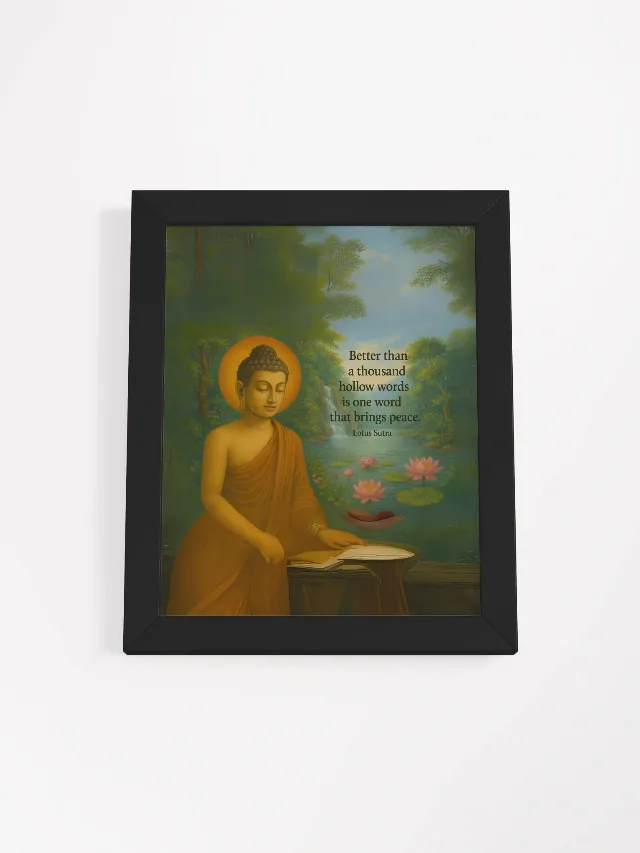
The Bodhisattvas of the Earth are the countless practitioners who rise from the ground in chapter fifteen of the Lotus Sutra. They are not visitors from another world. They are the people of this world, and Nichiren identified his own followers with them. The chapter asks ordinary people to take practice seriously where they already stand.
What happens in chapter fifteen
The chapter opens with a question of who will carry the teaching. Bodhisattvas who have arrived from other worlds offer to stay and teach the Lotus Sutra in this world. Shakyamuni declines. He says the world already has people who can carry the teaching.
Then the ground trembles and splits open. Countless bodhisattvas emerge from beneath the earth. They are described as splendid in appearance, and they come not as lone figures but as a vast company. Four great bodhisattvas lead them, each with a name that describes a quality of practice.
The assembly is astonished. Maitreya, a bodhisattva who speaks for the gathered listeners, asks the obvious question: where did these people come from, and who taught them? Shakyamuni answers that they are the disciples he has guided since the distant past.
That answer creates a second puzzle. The assembly knows how long Shakyamuni has been teaching in this life. The numbers do not fit. The question of how a teacher could have trained so many people in so short a time carries directly into the next chapter, where the Buddha reveals the length of his life.
Why the Bodhisattvas of the Earth come from the ground
The image is deliberate. These bodhisattvas do not descend from heaven. They do not arrive from a pure land somewhere else. They come up from the ground beneath the assembly's feet.
That detail carries the chapter's meaning. The people who will carry the teaching are not exceptional beings imported from elsewhere. They are produced by this world, this soil, this ordinary life. The earth is where things grow, and it is also where things are buried. Both are true of practice.
There is a second layer. The bodhisattvas emerge after the visitors from other worlds have offered to do the work. Shakyamuni does not accept the offer. The implication is not that outsiders are unwelcome. It is that the work belongs to the people who are already here, with their particular lives and their particular difficulties.
For a reader at home, that is a useful correction to the habit of waiting. It is easy to assume that practice will become serious when you find the right group, the right teacher or the right room. The chapter puts the emphasis on the ground you are standing on now. The Lotus Sutra guide sets the scene in the wider story of the sutra.
The four leaders and Superior Practices
The four leading bodhisattvas are named for the qualities they embody. Superior Practices leads them. The others are Boundless Practices, Pure Practices and Firmly Established Practices.
The names are not job titles. They describe a way of practising: steadily, without limit, without pretending to be pure, and without being easily moved. The fact that practice is led by a figure called Superior Practices, rather than by a figure called Victory or Power, is worth noticing.
Nichiren read this company as the people of his own time. He saw the emergence of the Bodhisattvas of the Earth as a promise that ordinary people in a difficult age would carry the Law, not as a story about a distant golden age. He identified his own work with the mission of Superior Practices.
Communities differ in how literally they read that identification. What is consistent in Nichiren's writings is the practical conclusion: the Law is carried by people who practise it in daily life, not by a spiritual elite.
What the chapter asks of you
The chapter does not ask you to imagine yourself as a cosmic being. It asks you to take your place.
That place is usually unglamorous. It is the kitchen where you chant before anyone else is awake. It is the bus stop where you silently repeat the words. It is the desk where you do a job that nobody applauds.
The Bodhisattvas of the Earth are described as countless. That number matters. It suggests that this is not a role for a few special people. It is a possibility for anyone willing to practise and to care about others.
There is also a warning in the story. The bodhisattvas emerge only after the visitors have been turned down. The chapter is not saying that help from outside is bad. It is saying that the work cannot be outsourced. Someone has to do it here.
If you have been waiting for permission to practise, this is the permission. You do not need a title. You do not need to be finished. You need a place to sit and a willingness to begin again.
A common misunderstanding
It is easy to turn the Bodhisattvas of the Earth into a kind of spiritual rank. The mind likes a hierarchy: first the ordinary people, then the serious practitioners, then the ones who have emerged from the ground.
The chapter resists that reading. The bodhisattvas are not presented as a reward for exceptional effort. They are presented as the natural inhabitants of this world, called to do the work that is already in front of them.
Another misunderstanding is to treat the story as a prediction about a future golden age. Nichiren did read it as a promise for his time. But the promise is not that everything will become easy. It is that the teaching will not be lost, and that ordinary people will carry it through difficulty.
If you catch yourself ranking practitioners, or ranking yourself against them, return to the image of the ground. The earth does not sort people before it grows anything.
How to hold the image in daily practice
You do not need to think about the chapter every time you chant. A simple connection is enough.
Before you begin, put both feet on the floor. Notice the ground under you. Then chant. That small gesture can hold the chapter's claim without turning it into a doctrine you have to defend.
When you finish, look at the day ahead and name one person you will meet. The bodhisattvas are described as a company, not a crowd of individuals. Practice is personal, but it is not private.
If you want to read the chapter itself, start with the emergence scene and Maitreya's question. The guide to the Lotus Sutra will show you where the chapter sits in the whole sutra. The glossary entry for the Bodhisattvas of the Earth gives the basic terms.
Try this today. Name one ordinary place where you are needed: a kitchen, a workplace, a school gate, a hospital ward. Chant one short session with that place in mind. Afterwards, do one small thing that makes it slightly better.
From Nichiren's writings. In The Heritage of the Ultimate Law of Life, Nichiren ties the inheritance of the Law to the Bodhisattvas of the Earth. He argues that this inheritance is received through faith and practice, not through status, and that it belongs to ordinary people who keep going.
Next step
Read the question on who the Bodhisattvas of the Earth are if you want a short answer to keep. If you practise without a group, practising on your own will help you build a rhythm that does not depend on a crowd. And the Lotus Sutra guide places this chapter beside the Life Span Chapter, which answers the question Maitreya leaves hanging.
When you are ready, the chant timer will keep the time while you take your place.