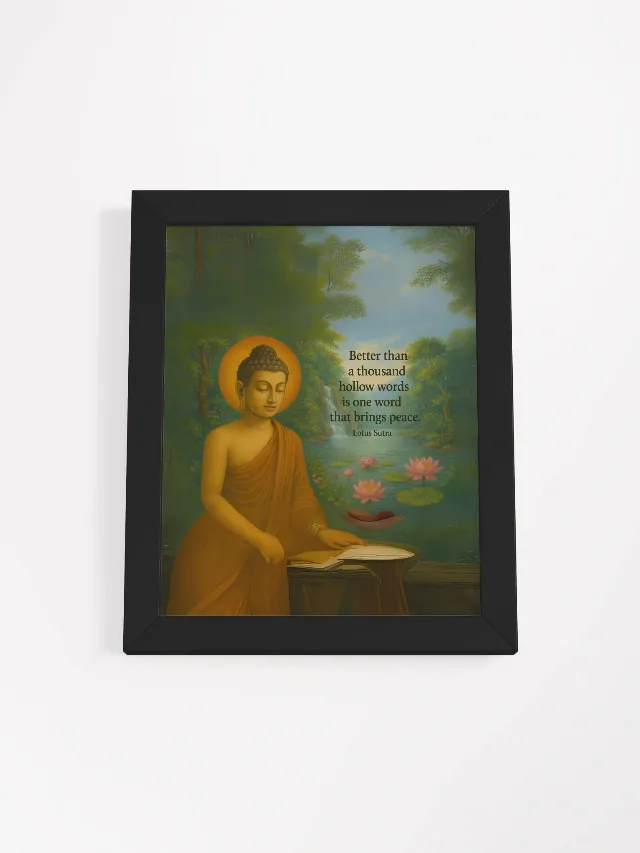
The Life Span Chapter is the sixteenth chapter of the Lotus Sutra. In it, Shakyamuni, the historical Buddha, sets aside the idea that he first became a buddha in his own lifetime. He describes a life that has been present through countless ages. Practitioners read the chapter as a statement about every life, including yours.
What happens in the Life Span Chapter
The chapter begins with a question the assembly has been circling for some time. Shakyamuni has taught for decades. Yet the Lotus Sutra describes him as having guided countless beings over immeasurable time. How can that be, if he only awakened under the tree of awakening in this life?
His answer is direct. His awakening did not begin in that lifetime. He describes a span of time so long that numbers fail, and says he has been teaching and guiding people throughout it. The traditional figure is often given as five hundred dust-particle kalpas, vast spans of time used as an image to stagger the imagination rather than to be counted.
Then comes the claim that changes the chapter's meaning. He is not a teacher who arrived recently and will soon leave. The life of the Buddha is immeasurable. The Law he teaches is not a temporary message for one generation.
For a reader at home, the argument is not really about chronology. It is about where you locate buddhahood. If the Buddha's awakening is ancient and ongoing, then the capacity to wake up is not a rare accident of history. It is part of life itself.
That is why the chapter is often treated as the heart of the sutra. Earlier chapters prepare the ground. Here the Buddha says who he has been all along.
The parable of the skilled physician
Near the end of the chapter, Shakyamuni tells a story. A physician has many children. He is called away on business. While he is gone, the children drink poison and fall sick.
When the father returns, he prepares a medicine and offers it to them. Some take it and recover. Others refuse. They are so confused by the poison that they cannot recognise their own father or trust what he gives them.
The physician does not force the medicine down their throats. He leaves again and sends word that he has died. The shock of the news brings the children to their senses. They take the medicine and are cured.
The story can sound harsh if it is read as a literal account of a father's trick. Read as a parable, it makes a different point. Love adapts. When the direct approach fails, the Buddha finds another way to reach people who cannot see what is good for them.
The parable does not ask you to read the father's supposed death as cruelty. It asks you to see how far the Buddha will go to wake someone up. The medicine has been there all along. The problem is the refusal.
There is an uncomfortable mirror in the story. Most people have refused something good for them at some point. A friend's advice, a doctor's instruction, a simple change that would have helped. The parable asks you to notice the medicine on the table before you ask why it is not working.
Why the chapter mattered to Nichiren
Nichiren returned to the Life Span Chapter in his writings. For him it was the place where the Lotus Sutra stops describing a Buddha far away and starts describing the Buddha in your own life.
He taught that the eternal Buddha and the Mystic Law are not two separate things. The Buddha of this chapter is not a person to bargain with. The chapter points to the life of the Law, which is present wherever someone chants and keeps faith with it.
This is one reason the chapter is bound up with the object of devotion in Nichiren's writings. The object is not a portrait of a distant figure. It is a way of focusing on the same awakened life that the chapter describes. Communities explain the details in different ways. What stays consistent is the direction: the treasure is not elsewhere.
If you want the larger picture, the guide to why the Lotus Sutra matters sets this chapter beside the rest of the sutra. The Life Span Chapter glossary entry gives the basic terms without the commentary. If you are new to the text, the Lotus Sutra guide explains its structure and its central parables.
What the chapter says about death
The chapter does not offer a map of what happens after death. It makes a larger claim: the life that is awake in you is not limited to the years you can count.
Many practitioners find that claim consoling at a funeral. Others find it abstract until loss arrives, and then it either helps or it does not. Both responses are honest. The sutra is not asking you to feel a particular way.
What it does ask is that you stop treating death as the final word about a person. Nichiren's letters to grieving followers do not tell them to stop crying. They point to a confidence that winter gives way, and they treat grief as something to bring into practice rather than something to hide from it.
If you are in the middle of a loss, the guide to chanting through grief is a more practical place to start. The question on death and the afterlife covers what the writings do and do not say, without filling the gaps with guesswork.
How to read the chapter without getting lost
You do not need to read the whole sutra to meet this chapter. Start with the parable. Read it aloud, slowly, and notice where you recognise yourself: in the father, in the children, in the medicine left on the table.
Many practitioners recite the verse section of the chapter, the jigage, as part of gongyo, the short recitation practised morning and evening. If you are learning it, the guide to learning gongyo step by step will help more than trying to memorise the whole thing at once. Recitation is not a performance. It is a way of letting the words become familiar.
The names and numbers can overwhelm a first reader. Skim them. The chapter is not an exam. Read for the argument, then go back for the detail.
One useful habit is to read a single passage three times. The first time, read for the story. The second time, read for the claim it is making. The third time, read for what it asks of you. Ten minutes is enough.
Try this today. Set a timer for ten minutes. Read the parable of the skilled physician slowly. Then write one sentence about something you have been treating as finished: a friendship, a habit, a hope. Do not try to fix it. Just name it, and chant one short session with that sentence in view.
From Nichiren's writings. In The Object of Devotion for Observing the Mind, Nichiren explains that the object of devotion should express the Buddha revealed in the Life Span Chapter, whose life is not limited to one lifetime. He reads the chapter as showing that the Law is present in ordinary life, not only in a distant past.
A gentle note. Chanting can sit alongside professional care, but it is not a substitute for it. If you are in crisis or need someone to talk to, please reach out to a local helpline through findahelpline.com.
Next step
The Life Span Chapter is one door into the Lotus Sutra. The guide to why the Lotus Sutra matters shows how this chapter fits with the parables and the other great images. If the chapter raised questions about loss, read chanting through grief next. And the Life Span Chapter entry keeps the terms close while you read.
When you are ready to sit, the chant timer will hold the time for you. Five minutes is enough for today.