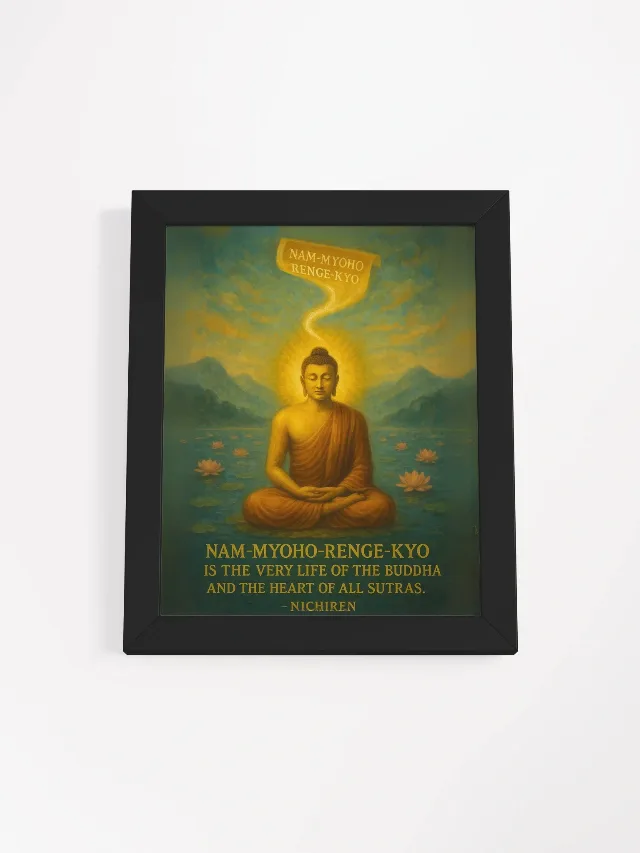
The Gohonzon is a scroll that practitioners use as a focus for chanting. It represents the enlightened life within ordinary people, not a god outside them. Nichiren inscribed it so that ordinary people could turn towards that life. It is a mirror for faith, not a charm.
A focus, not a god
The first thing to understand is what the Gohonzon is not. It is not a deity to be appeased. It is not a lucky object that brings good weather or winning numbers. It is not a substitute for the chant or for your own effort.
It is a focus. When you sit in front of it, you have somewhere to put your eyes and a reminder of what you are doing. The scroll does not do the practice for you. It helps you do it.
This matters because people sometimes treat the Gohonzon as a kind of insurance. They keep it in a cupboard and take it out only when something goes wrong. That is not how the practice works. The Gohonzon is for the ordinary days, not only the emergencies.
Think of a photograph of someone you love. The photograph is not the person. It does not hear you or answer you. But it helps you remember, and remembering changes how you act. The Gohonzon works a little like that, except that what it points to is your own life.
At the centre of the Gohonzon are the characters for Nam Myoho Renge Kyo. Around them are figures from the Lotus Sutra: Shakyamuni Buddha, Many Treasures Buddha, the Bodhisattvas of the Earth and others. The arrangement is not random. It is a picture of the teaching in visual form.
The scroll also represents the ten worlds, from hell to Buddhahood. You will find figures and names that stand for the different conditions a person can experience. The point is not to memorise the list. It is to see that all of those conditions are held within one life.
Different communities have different forms of the Gohonzon, different ways of reproducing it and different customs around it. The details vary. The central purpose does not.
You do not need to read Japanese to use it. The scroll is not a text to be studied from top to bottom. It is a whole picture, meant to be taken in at a glance and returned to day after day.
Why Nichiren inscribed it
Nichiren lived in a time when formal Buddhist study was often reserved for monks and scholars. The Gohonzon was a way of making the practice available to ordinary people: a single object, a single chant, no requirement of wealth or scholarship.
In The Object of Devotion for Observing the Mind, Nichiren explains that the Gohonzon is an object for looking into one's own mind. It is not a power outside you. The ten worlds it depicts are the movements of your own life.
That is why the practice is sometimes described as a mirror. You sit in front of the scroll, you chant, and you meet yourself. The scroll does not flatter you. It does not condemn you. It simply reflects.
The inscription is also a statement of trust. Nichiren did not keep the practice for a small circle of disciples. He wrote it down in a form that could be copied, carried and used in ordinary homes.
That accessibility is easy to forget when you see a large, formal scroll displayed in a hall. The same teaching is meant to be used at a kitchen table. The scale changes; the practice does not.
The ten worlds are ten conditions of life: hell, hunger, animality, anger, humanity, heaven, learning, realisation, bodhisattva and Buddhahood. They are states you move through in a single day, not destinations to wait for after death.
A traffic jam can produce anger. A kind word can produce heaven. A moment of quiet can produce something closer to learning or realisation. Buddhahood is not a permanent high. It is a capacity that can be present even when the other conditions are loud.
The Gohonzon shows all ten. That is the point. You are not asked to feel only the good ones. You are asked to see the whole of your life and to chant from the middle of it.
This is why the scroll can be comforting on a bad day. It does not pretend that the bad day is not happening. It shows that the whole range of human experience is included in the practice.
You do not have to identify with every figure. You only need to see that none of your states is outside the picture. The angry moment, the hungry moment, the ordinary moment: all of them are held.
The scroll is not a test of belief. It is a place to look.
How practitioners relate to it
For many practitioners, the Gohonzon is kept in a butsudan, the altar cabinet or shelf where the scroll is housed. They open the altar in the morning, offer water, light a candle and chant. In the evening, they close it.
The relationship is meant to be respectful, not fearful. You do not have to bow in a particular way to avoid bad luck. You do not have to keep the scroll hidden from visitors. You do not have to panic if the cat knocks something over.
Some people receive a Gohonzon through a local community. Others practise for years without one. Communities differ on this, and there is no need to rush. The chant is the practice; the scroll is a support.
If you do have a Gohonzon, treat it with care. Keep it clean, place it securely and handle it with clean hands. That is simple respect, not superstition.
What it is not
It is not a talisman. It does not protect the house on its own. It does not bring money or keep bad things from happening.
It is not a promise. You can chant in front of it every day and still have a difficult year. The practice is not a contract that promises a smooth life.
It is not an idol. You are not worshipping paper and ink. You are using a form to turn your attention towards something deeper.
And it is not a substitute for action. Nor is it a replacement for ordinary effort. If you need to make a phone call, make the phone call. If you need to ask for help, ask for help. The Gohonzon is a place to steady yourself before you do what needs doing.
None of this makes the object less important. It makes it more honest. A focus is useful precisely because it is not asked to be a god.
Try this today. Sit in front of a blank wall or a window for three minutes. Notice what you expect an object to do for you. Then chant one slow Nam Myoho Renge Kyo and notice what you are actually doing.
From Nichiren's writings. In The Real Aspect of the Gohonzon, Nichiren describes the Gohonzon as the real aspect of the Buddha's life, not a mere picture or symbol. The scroll is a form through which ordinary people can approach that life. The paper is not the point; the life it points to is.
Next step
For the wider context, read The Gohonzon: What It Is and How to Relate to It.
If you do not have a Gohonzon yet, Chanting Before You Have a Gohonzon explains how to begin without one.
For a closer study of the object of devotion, read The Object of Devotion for Observing the Mind.
The videos page shows how practitioners set up and care for a simple altar.