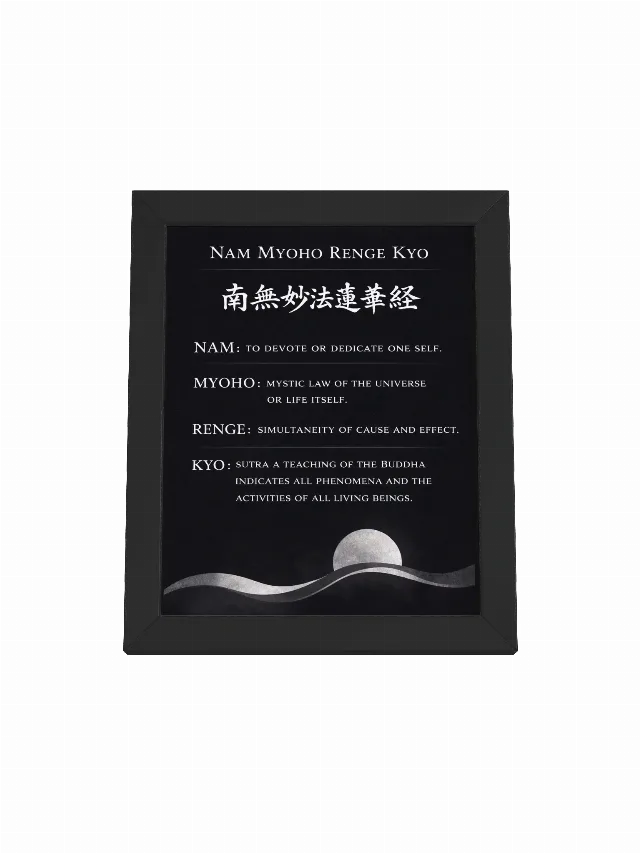
Nam Myoho Renge Kyo means "I devote myself to the wonderful law of the Lotus Sutra". It is a statement of devotion rather than a request sent to a god. Nichiren taught that these words contain the heart of the Lotus Sutra, and that chanting them is how an ordinary person can live that teaching.
Nam Myoho Renge Kyo meaning, word by word
The phrase is Japanese, but its parts travelled a long way to get there: from Sanskrit into Chinese, and from Chinese into Japanese. Taking it apart helps, as long as you remember that a chant is not a dictionary entry. The meaning lives in the whole act as much as in the parts.
Nam. From the Sanskrit namas, to bow, to revere, to devote oneself. In the chant it is the turning of the whole person towards the law. It is not "please give me". It is closer to "I place my life here".
Myoho. Myo is wonderful, mysterious, hard to grasp with the ordinary mind. Ho is law. Together, the wonderful law: the way life actually works, deeper than your current mood or opinion.
Renge. The lotus. Ren is lotus, ge is flower.
Kyo. Sutra, teaching. It is also the sound of that teaching spoken aloud.
So the whole phrase is usually translated as "devotion to the wonderful law of the Lotus Sutra". That is accurate, but it is thin. A better way to hold it is as a sentence you are learning to mean.
Why "Nam" and not "Namu"?
Both are used. Namu is the fuller transliteration of the Sanskrit word; Nam is the shorter form, and it is the one usually written in the title. Neither is more correct, and neither brings you closer to the practice. This answer explains the history if you want the detail.
If you learned one form and then meet the other, you have not been doing it wrong. The phrase is the same phrase.
Where do the words come from?
The trail starts with the Lotus Sutra itself, a Buddhist scripture composed in India and read across East Asia. Its Sanskrit title is Saddharma-pundarika-sutra. Saddharma means the true or wonderful law. Pundarika means the white lotus. Sutra means a discourse or teaching.
That title was translated into Chinese in the early fifth century, in a version that became the one East Asia read and recited. In Chinese it is Miao-fa-lien-hua-ching. Say it slowly and you can hear the ancestors of the Japanese words: miao became myo, fa became ho, lien-hua became renge, ching became kyo.
The Japanese reading of that Chinese title is Myoho Renge Kyo. The nam at the front is the devotion, the act of turning towards it. Nichiren taught the whole phrase, devotion included, as the practice for ordinary people.
So the words are older than Nichiren and older than the Chinese translation he inherited. The Nam Myoho Renge Kyo meaning is layered: a Sanskrit devotion, a Chinese title, a Japanese reading. When you chant, you are using a sentence that has been carried for a very long time.
Why is it called the "wonderful law"?
Law here does not mean a rule imposed from outside. It means the way things work: cause and effect, the interdependence of a life and its surroundings, the fact that a single moment of experience contains more than you can see.
Myo is often explained with two images. One is a lamp in a dark room: the room does not change, but everything in it becomes visible. The other is medicine: something that revives a person who has run down. Neither image is magic. Both describe a shift in what you can see and what you can do.
The word "wonderful" is not a promise that life will feel wonderful. It points to a depth in ordinary experience that is easy to miss. A conversation with a difficult relative, a job that pays the bills, a body that hurts in the morning: the law is not somewhere else, waiting for better conditions.
None of this makes the Nam Myoho Renge Kyo meaning complicated. It makes it more ordinary, not less.
What does the lotus have to do with it?
The lotus is not chosen for its beauty alone. It is chosen for two habits.
First, it flowers and seeds at the same time. Most plants show you cause now and result later. The lotus holds both in one moment. That is the image for a teaching in which cause and effect are not two separate worlds.
Second, it roots in mud and opens above the water. The mud is not removed before the flower appears. The image says that insight is not found by escaping ordinary life. It grows out of it.
A lotus does not clean the pond. It simply shows what a flower can do with what is there. That is a more modest image than it first appears, and a more useful one.
This is why the title is not just a name. It is a compressed argument about how a life changes.
What does kyo mean, and why does sound matter?
Kyo is the sutra, the teaching. It is also the sound of the teaching. In Nichiren's practice the two are not separated. You do not read the title silently and then act on it later. You say it, and the saying is the act.
Sound does something that reading does not. It occupies the body. The breath lengthens, the shoulders drop, the voice fills the room. A thought can be argued with. A sound you are making is harder to ignore.
Communities differ in how much they emphasise the sound, the faith or the study. What is consistent in Nichiren's writings is that the title is to be chanted, not merely understood.
What did Nichiren teach about these words?
Tradition dates Nichiren's first public declaration of the practice to 1253: the title of the Lotus Sutra, chanted, for the Latter Day of the Law. The act is the hinge of his life.
The Latter Day of the Law, mappo, is the long period in which the teaching has been largely forgotten and people practise without a living teacher to guide them. Nichiren taught that in this time the simple practice of the title was the way for ordinary people, not a second-best option for people who could not manage anything harder.
He also taught that the five characters myo, ho, ren, ge, kyo are not a label attached to the sutra. They are the sutra's heart, pressed into a form a person can say. That is why the practice is short. It is meant to be carried into a working life.
Two ideas sit underneath this:
Chanting the title is how a person turns towards both at once. Not by understanding them first, but by saying the words until the understanding catches up.
These are not separate doctrines. If a single moment contains the whole of life, then the moment you spend chanting is not a pause from life. It is life, attended to. That is why the practice asks for no special conditions: no retreat, no quiet mind, no perfect week.
Why chant a title instead of the whole sutra?
Because the whole sutra is long, and many people in Nichiren's time could not read it, let alone copy it by hand. A practice that required literacy and leisure would exclude the people who most needed it. The title is short enough for a farmer, a parent, a sick person, a child. Short enough to remember when the day falls apart.
There is a second reason. A long text invites you to master it. A short phrase invites you to return to it. Nichiren's teaching is less interested in your expertise than in your steadiness.
Does that mean the rest of the sutra does not matter?
No. Nichiren wrote about the sutra for his whole life, and study is part of the practice for many people. The title is the door, not the whole house. The Lotus Sutra guide is the place to start if you want to walk through it.
Is it a prayer, a mantra or a vow?
A prayer, in the ordinary sense, asks. A mantra is a sound repeated to produce a state. A vow is a direction you set and return to.
Nam Myoho Renge Kyo is closest to a vow. It does not ask a creator god to intervene, because in Nichiren's teaching there is no creator god to ask. It does not promise a trance. It states a devotion and repeats it until the statement becomes a habit of attention.
People do chant for things: a job, a partner, a clear scan, a child's exam. The practice does not forbid this. It asks you to bring the wish honestly and then to notice what you are willing to do.
Communities differ on how they describe what happens when you chant. Some speak of a power in the words themselves. Others speak of the mind being steadied. What is consistent is the instruction: chant, and let the practice show you.
A vow is not a feeling. It is a direction you take on the days you do not feel like taking it. That is why the practice is repeated: not because the words stop working, but because you need reminding.
Does the English translation work as a chant?
You can read the translation, and it is worth reading once. "I devote myself to the wonderful law of the Lotus Sutra" tells you what you are doing.
But the translation is not a substitute for the chant. The Japanese phrase has a rhythm, a length and a set of sounds that the English sentence does not. It is also the form that has been passed down, in the same way a song is passed down. Changing the words changes the practice.
Some people like to read a translation quietly before they chant, as a way of reminding themselves what they are saying. That is a useful habit. Then they put the paper down and say the words they were given.
One more thing about the translation. "Wonderful law" can sound soft, even sentimental. The older English word "mystic" is closer in one sense and further in another, because it suggests something occult. The law being pointed at is not hidden in a special place. It is hidden in plain sight, in the ordinary mechanics of cause and effect.
Why not translate it and chant in English?
You can, and some people do. The practice is not a secret code, and sincerity does not depend on Japanese. Still, many communities chant the traditional phrase, and learning it connects you to everyone else saying the same sounds at the same time. If the Japanese is a barrier, chant along with a recording until it is not.
What does chanting it actually do?
At the simplest level, it interrupts. The mind is usually running a loop of rehearsal, complaint and worry. The chant gives that loop somewhere else to go.
The breath slows. You hear your own voice. The body settles into a chair. For five minutes, there is one thing to do.
Practitioners often describe a sense of steadiness afterwards, a clearer sense of what to do next, and the return of a choice they had forgotten they had. Some describe nothing at all for weeks. Both are ordinary.
None of this is a guarantee. Chanting is not a substitute for a doctor, a lawyer, a repair, or a difficult conversation. It is a way of steadying the person who has to have those conversations. If you have been told that the chant will fix everything, that is not what Nichiren taught, and it is not what this site teaches.
How long before something changes?
There is no timetable. Some people notice a quieter hour after the first session. Some notice nothing for a month and then realise they have stopped dreading a particular meeting. Others find the practice useful precisely because it asks nothing of them but the repeating.
The honest answer is that the change is usually small and cumulative, like sleep. You do not remember the night it improved. You notice months later that you are less tired.
Can you chant it for someone else?
Yes. Many people chant with a specific person in mind: a parent in hospital, a friend in a difficult year, a child who is struggling. The practice does not require the other person's permission, and it does not make them do anything. It changes the person doing the chanting, which is often the only thing within reach.
Is it the same as mindfulness?
There is overlap. Both ask you to notice when the mind has wandered and to come back. But mindfulness usually asks you to observe what arises without adding anything. Chanting adds words, devotion and a view of life. It is not a relaxation technique, and it is not trying to empty the mind.
If mindfulness helps you, it will not conflict with this. Chanting does not replace medical care or therapy.
What are the common misunderstandings?
- "It is a magic formula." No. The words are not a code that forces the world to comply.
- "It means worshipping a book." No. The sutra points to a law of life. The words are a finger, not the moon.
- "I have to feel something." No. Feeling is weather. Practice is the ground you stand on whatever the weather is doing.
- "It is positive thinking." No. It does not ask you to deny what is hard. This answer explains the difference.
- "I have to be Buddhist." No. People chant from many backgrounds, and you do not have to sign anything. More here.
- "I have to get the pronunciation perfect." No. How to chant has a plain pronunciation guide, and the short version is: say it steadily and do not strain.
Try this today. Say the phrase once, slowly, and notice which word your attention lands on. Write that word at the top of a page. Then chant for three minutes. Afterwards, write one sentence about what changed in your body, if anything.
From Nichiren's writings. In The Object of Devotion for Observing the Mind, Nichiren sets out the teaching that a single moment of life contains the ten worlds and the three thousand realms. The object of devotion he describes is not a picture of somewhere else. It is a way of seeing what is already true of the person who sits before it. Chanting the title is how a person turns towards that.
A gentle note. Chanting can sit alongside professional care, but it is not a
substitute for it. If you are in crisis or need someone to talk to, please reach
out to a local helpline through findahelpline.com.
Next step
If you want to say the words rather than study them, how to chant Nam Myoho Renge Kyo walks through posture, pace and a first five minutes.
If you want the text behind the title, the Lotus Sutra guide explains its story, its chapters and why Nichiren turned to it.
If you are curious about the recitation that often comes before the chant, gongyo shows what it is and how to learn it.
The chant timer is the simplest way to begin today: five minutes, a bell, and no decisions to make.